


The pursuit of the perfect espresso shot is a journey familiar to every coffee enthusiast. It is a frustrating dance of variables where one day you pull a shot of liquid gold, and the next, a sour or bitter disappointment, despite seemingly changing nothing. If this sounds familiar, the culprit is often hiding in plain sight: your coffee dose. While using a scoop or a grinder’s timer seems convenient, these methods introduce massive inconsistencies. The secret to achieving repeatable, cafe-quality espresso at home lies not in time or volume, but in precision. This article will explore why weighing your coffee beans is the single most important step for consistency, transforming your espresso-making from a game of guesswork into a predictable science.
The problem with volume and time
For decades, many home baristas have relied on two common methods for dosing coffee: using a measuring scoop (volume) or a grinder’s built-in timer (time). While simple, both methods are fundamentally flawed because they ignore a critical factor: density. Coffee beans are not a uniform product; their density changes based on several factors.
- Roast level: As coffee beans are roasted, they lose moisture and expand. This means darker roasts are larger and less dense than lighter roasts. A scoop filled with a dark, oily bean will weigh significantly less than the same scoop filled with a light, dense bean.
- Bean origin and processing: Different coffee varietals from various regions have inherently different sizes and densities.
- Grind size: The rate at which coffee grinds exit the burrs is not constant. Finer grinds flow more slowly than coarser grinds, so a 5-second grind time will yield a different weight depending on your dial.
- Hopper level: The amount of beans in your grinder’s hopper also impacts the feed rate. A full hopper exerts more pressure, pushing more beans through the burrs per second than a nearly empty one.
Relying on time or volume means your dose could vary by one, two, or even three grams from shot to shot. This seemingly small difference is enough to completely throw off your extraction and send you down a frustrating rabbit hole of adjustments.
Dose: The foundation of your espresso recipe
Think of an espresso shot not as a single action, but as a recipe with three core components: the dose (the dry grounds in), the yield (the liquid espresso out), and the time (the duration of the extraction). Of these, the dose is the most important independent variable. It is the foundation upon which the entire shot is built. If the foundation is unstable, the entire structure will be compromised.
Imagine trying to bake a cake where the amount of flour changes every time. You would never get a consistent result. Espresso is no different. A change of just one gram in an 18-gram basket is a more than 5% variation. This directly impacts how water flows through the coffee puck. A lower dose offers less resistance, leading to a fast, under-extracted, and sour shot. A higher dose increases resistance, often causing a slow, over-extracted, and bitter shot. By failing to control your dose, you are constantly trying to adjust your grind size to compensate for a moving target, never truly knowing which variable caused the problem.
How weight unlocks consistent extraction
When you start weighing your dose, you eliminate the biggest source of inconsistency. By locking in this foundational variable, the process of “dialing in” your espresso becomes methodical and logical. You are no longer guessing; you are making controlled adjustments. With a consistent dose, you can confidently attribute changes in your shot time and taste to the one variable you are intentionally changing: the grind size.
If your recipe calls for 18 grams of coffee and your shot runs too fast, you know with certainty that the cause is your grind setting being too coarse. The solution is simple: make the grind finer. Conversely, if the shot chokes your machine and runs too slowly, your grind is too fine. This scientific approach removes frustration and allows you to make deliberate, repeatable adjustments. The table below illustrates the difference between a chaotic, time-based workflow and a controlled, weight-based one.
| Variable | Shot 1 | Shot 2 | Shot 3 | Outcome |
|---|---|---|---|---|
| Scenario A: Grinding by Time (e.g., 5 seconds) | ||||
| Dose (g) | 17.2g | 18.5g | 17.8g | Unpredictable dose |
| Yield (g) | 36g | 36g | 36g | Kept constant |
| Time (s) | 22s | 35s | 28s | Wildly inconsistent |
| Taste | Sour, under-extracted | Bitter, over-extracted | Decent | Inconsistent results |
| Scenario B: Grinding by Weight | ||||
| Dose (g) | 18.0g | 18.0g | 18.0g | Locked in |
| Yield (g) | 36g | 36g | 36g | Kept constant |
| Time (s) | 23s (grind too coarse) | 33s (grind too fine) | 29s (dialed in) | Predictable adjustments |
| Taste | Sour -> Adjust finer | Bitter -> Adjust coarser | Balanced & Sweet | Consistent, repeatable results |
The essential tools for weighing your dose
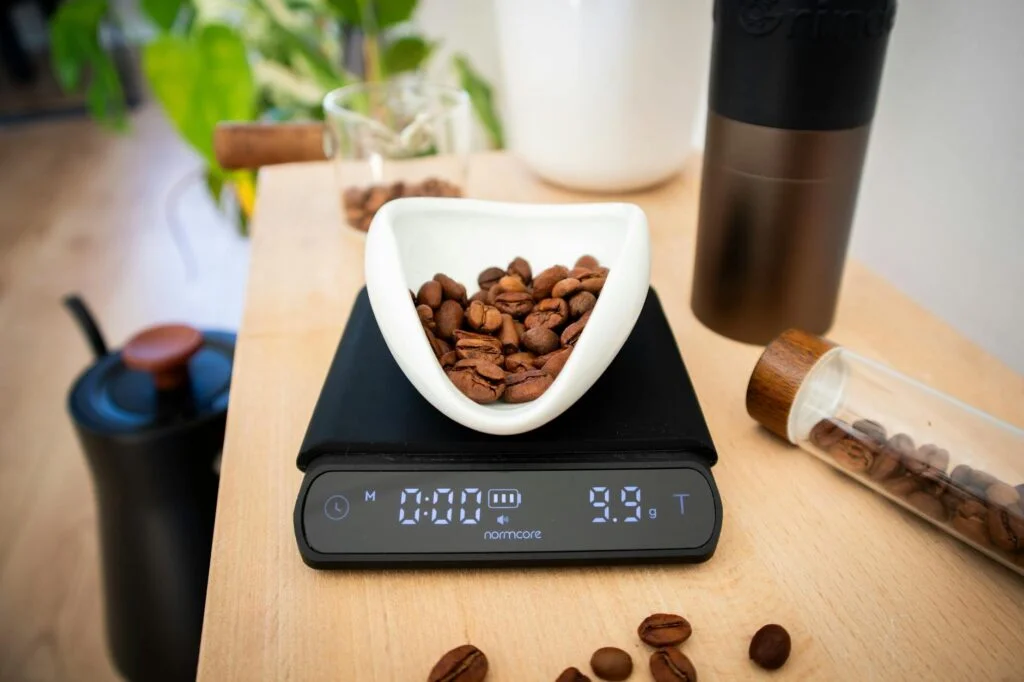
Making the switch to grinding by weight is simple and requires only one piece of equipment: a digital coffee scale. This is not the place to use a kitchen scale that measures in whole grams. For espresso, precision is key.
Here is what to look for in a good coffee scale:
- Accuracy to 0.1 grams: This level of precision is non-negotiable for accurately dosing espresso.
- Fast response time: The scale should register weight changes quickly so you don’t overshoot your target dose.
- A built-in timer: While not essential for weighing the dose, a timer is incredibly helpful for timing your extraction, allowing you to use one device for two key metrics.
- Compact size: Ensure the scale is small enough to fit on your espresso machine’s drip tray to weigh your final shot.
Your workflow will be simple. You can either weigh your whole beans before putting them in the grinder (a method known as single dosing) or place your portafilter on the scale, tare it to zero, and grind directly into it until you hit your target weight. Both methods achieve the same goal: a perfectly consistent dose, every single time.
In conclusion, the path to better espresso is paved with precision. While factors like grind size, water temperature, and puck preparation are all important, none can be properly controlled without a consistent foundation. Grinding by volume or time leaves you at the mercy of countless variables like bean density and hopper level, making true repeatability impossible. By embracing the simple act of weighing your dose with a 0.1g scale, you eliminate the most significant source of inconsistency in your workflow. This single change empowers you to make logical adjustments, understand cause and effect, and finally replicate that perfect shot on demand. It is the most impactful and cost-effective upgrade any home barista can make.