

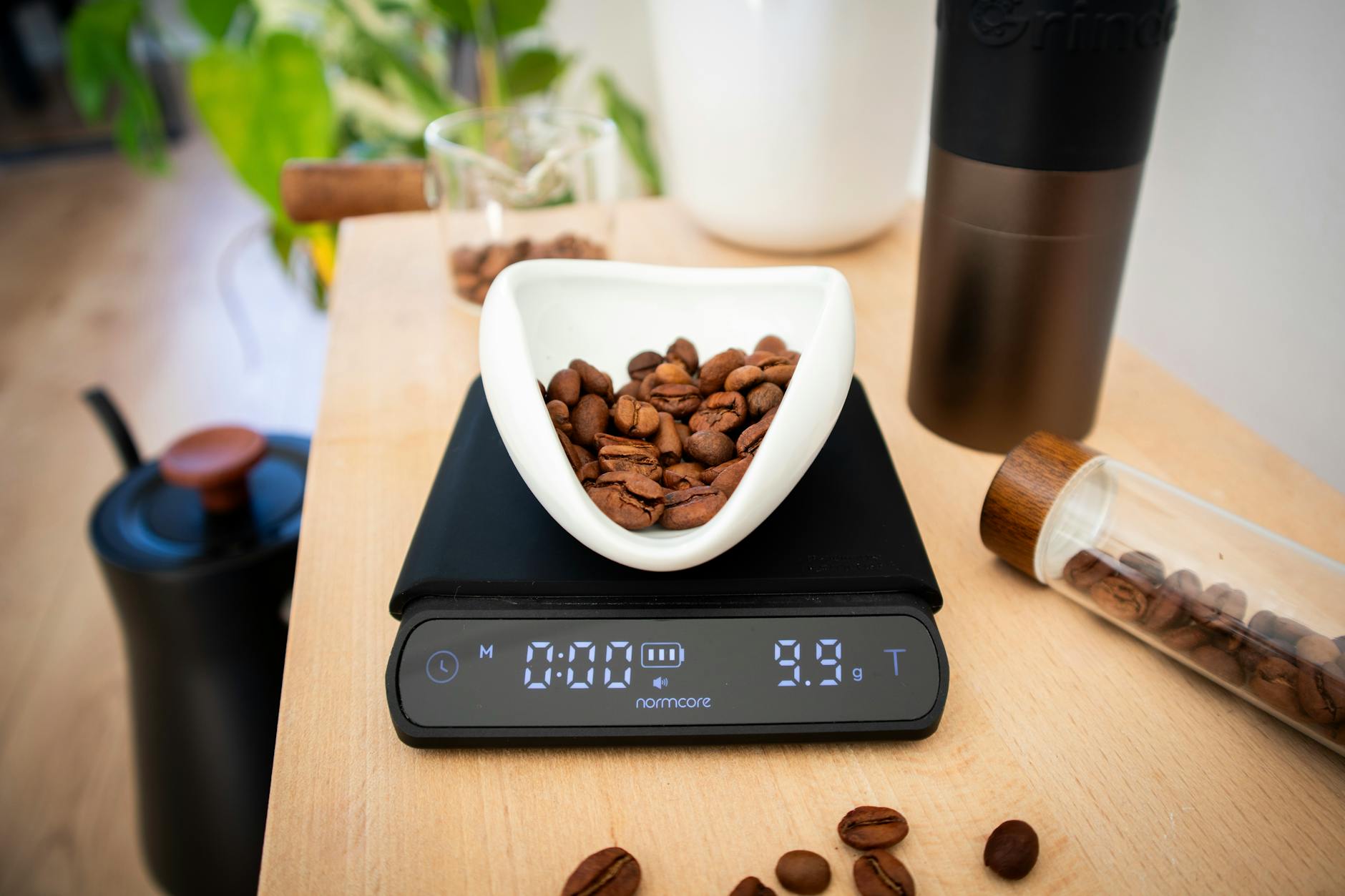
The quest for the perfect espresso shot is a journey many coffee lovers embark on. We invest in quality beans, powerful grinders, and gleaming espresso machines, all in pursuit of that rich, syrupy, and flavorful extraction. Yet, a common practice often stands in the way of achieving consistent results: measuring shots by volume. Using the markings on a shot glass seems intuitive, but it introduces a significant variable that can sabotage your efforts. This article will explore why abandoning the shot glass in favor of a digital scale is the single most important step you can take to elevate your espresso game. We will delve into the science of crema, the importance of brew ratios, and how weighing your espresso provides the precision needed for repeatable, delicious coffee every single time.
The problem with volume: Meet crema
At first glance, a freshly pulled espresso shot appears to be a uniform liquid. However, it’s composed of two distinct parts: the dark, liquid coffee and the reddish-brown foam on top, known as crema. Crema is a complex emulsion of coffee oils, proteins, and sugars, but most importantly, it’s packed with carbon dioxide (CO2) gas released from the beans during extraction. This gas is the primary reason why measuring by volume is so unreliable.
The amount of crema a shot produces is highly variable. It depends on several factors:
- Bean freshness: Freshly roasted beans contain a lot of trapped CO2. As they age, this gas dissipates. A shot pulled with beans roasted three days ago will have significantly more crema—and therefore more volume—than a shot pulled with the same beans two weeks later, even if the amount of actual liquid coffee is identical.
- Roast level: Darker roasts are more porous and can release their CO2 more readily, often creating a thicker, more robust-looking crema.
- Bean origin: Certain coffee varieties, like Robusta, are known for producing an abundance of crema compared to their Arabica counterparts.
Because crema is mostly gas, its volume is inconsistent and it begins to dissipate the moment the shot is pulled. A 30 ml shot might be 10 ml of liquid and 20 ml of crema one day, and 20 ml of liquid and 10 ml of crema the next. You are measuring a combination of liquid and air, which is not a reliable way to gauge the strength or extraction of your coffee.
The science of extraction and the brew ratio
To move from guesswork to precision, we need to talk about the most fundamental concept in modern espresso making: the brew ratio. A brew ratio is simply the relationship between the weight of the dry coffee grounds (your dose) and the weight of the final liquid espresso (your yield). This ratio, not volume, is what truly defines the strength and flavor profile of your shot.
It’s expressed as a simple formula: Dose : Yield. For example, a common starting point for a standard espresso is a 1:2 ratio. This means for every 1 gram of dry coffee grounds, you want 2 grams of liquid espresso in your cup. If you start with an 18-gram dose, your target yield would be 36 grams.
Controlling this ratio allows you to craft different styles of shots:
- Ristretto (short shot): A tighter ratio, like 1:1 or 1:1.5. This results in a more concentrated, syrupy shot with intense, often sweeter flavors. (e.g., 18g dose -> 18-27g yield).
- Espresso (standard shot): Typically a 1:2 to 1:2.5 ratio. This is the benchmark for a balanced shot with a good mix of sweetness, acidity, and bitterness. (e.g., 18g dose -> 36-45g yield).
- Lungo (long shot): A wider ratio, like 1:3 or more. This shot is more diluted and can highlight more delicate, tea-like notes, but runs the risk of over-extraction and bitterness if not done carefully. (e.g., 18g dose -> 54g+ yield).
You simply cannot control this crucial variable with a shot glass. A gram is always a gram, but as we’ve seen, a milliliter of espresso is not always a milliliter of coffee.
Consistency is king: The power of a scale
The ultimate goal for any barista, whether at home or in a café, is repeatability. When you pull that one “perfect” shot, you want to be able to do it again tomorrow. A digital scale is the key to unlocking this consistency. By weighing your dose in and your yield out, you establish a precise recipe that can be replicated time and time again.
Furthermore, a scale transforms you from a passive observer into an active troubleshooter. When a shot doesn’t taste right, weight and time give you the data you need to diagnose the problem. Let’s say your recipe is 18g in, 36g out in about 30 seconds.
- Shot tastes sour and weak: You check your scale and see you got 36g out in only 18 seconds. The water flowed through the coffee too quickly, under-extracting it. The solution: Grind your coffee finer to create more resistance.
- Shot tastes bitter and harsh: You check your scale and see it took 45 seconds to get to 36g. The water struggled to get through the puck, over-extracting it. The solution: Grind your coffee coarser to allow the water to flow more freely.
This data-driven approach removes the frustration from dialing in new beans and allows you to make small, informed adjustments to consistently hit the flavor profile you desire.
Getting started with a simple workflow
Integrating a scale into your routine is simple and requires only one piece of equipment: a digital coffee scale. Look for one with 0.1-gram precision, a fast response time, and a built-in timer. Water resistance is also a huge plus.
Here’s a basic workflow:
- Place your empty cup on the scale and press the ‘tare’ or ‘zero’ button.
- Position the cup and scale under your portafilter.
- Start the extraction and a timer at the same time (many coffee scales do this automatically).
- Watch the weight on the scale climb. As you approach your target yield, be prepared to stop the shot.
- Stop the machine just before you hit the target (e.g., at 34g for a 36g goal), as a few extra grams will drip into the cup after you stop the pump.
- Note the final weight and time. Taste the shot. If it’s delicious, you now have a precise recipe: for example, 18g in, 36g out, in 28 seconds.
To help visualize how ratios affect your final cup, here is a simple guide:
| Ratio | Name | Example (18g Dose) | Typical Flavor Profile |
|---|---|---|---|
| 1:1.5 | Ristretto | 27g yield | Concentrated, syrupy, intense sweetness, muted acidity. |
| 1:2 | Espresso | 36g yield | Balanced, well-rounded with a mix of sweetness and acidity. |
| 1:2.5 | Espresso | 45g yield | Slightly less body, highlights clarity and brighter notes. |
| 1:3 | Lungo | 54g yield | Thinner body, tea-like, can become bitter if over-extracted. |
In conclusion, while the volumetric shot glass has been a long-standing symbol of espresso, it’s a tool of imprecision in a craft that thrives on accuracy. The variable and fleeting nature of crema makes measuring by volume a gamble, leading to inconsistent and often frustrating results. By switching to a digital scale, you replace this guesswork with data. You gain control over the most important variable in your recipe—the brew ratio—which allows for unparalleled consistency, effective troubleshooting, and the ability to replicate your best shots every single day. Investing in a simple coffee scale is not an act of obsessive perfectionism; it is the single most effective upgrade you can make to your espresso setup, empowering you to brew truly exceptional coffee with confidence.
 No products in the cart.