


Master your Flair: A guide to using a scale for consistent espresso
The Flair Espresso maker is a beautiful piece of engineering that puts you in complete control of the brewing process. There’s an incredible satisfaction in pulling the lever and creating a rich, syrupy shot of espresso by hand. However, that manual control can also be a source of frustration. Why was yesterday’s shot perfect and today’s a sour disappointment? The answer often lies in tiny, invisible inconsistencies. This is where a simple digital coffee scale transforms from a “nice-to-have” accessory into the single most important tool in your arsenal. This guide will walk you through exactly how to use a scale to eliminate guesswork, introduce precision, and finally achieve the repeatable, delicious results you crave from your Flair.
Why precision is the secret to great espresso
Before we place a single bean on the scale, it’s crucial to understand why it matters so much. Espresso extraction is a delicate chemical reaction. You’re forcing hot water through a tightly packed bed of coffee grounds at high pressure. Tiny changes to any variable can have a massive impact on the final taste. The three core variables you control are the dose (the weight of dry coffee grounds), the yield (the weight of the liquid espresso in your cup), and the time it takes to extract.
Think of this as a recipe. If you were baking a cake and the recipe called for 100g of flour, you wouldn’t just guess with a random scoop. The same principle applies here. Without a scale, you are essentially guessing your recipe every single time. This is especially true with a manual machine like the Flair, where you are the machine. A scale removes the guesswork and empowers you to be deliberate, turning random chance into a reliable process.
Measuring your dose: The foundation of every shot
Everything starts with the coffee. Your dose is the foundation upon which your entire shot is built. Using a volumetric scoop might seem “close enough,” but the density of coffee beans can vary significantly based on the roast level and origin. A scoop of dark, oily beans will weigh less than the same scoop of a light, dense roast. This inconsistency is the first domino to fall in a chain reaction of poor extraction.
Your workflow should start here:
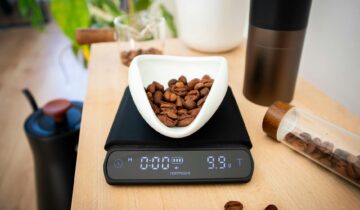
- Weigh your whole beans: Before you grind, place your portafilter basket or a small cup on the scale, tare it to zero, and weigh out your desired amount of whole beans. For most Flair models, this is typically between 14g and 18g.
- Aim for consistency: By starting with the exact same weight of coffee for every shot, you ensure the puck depth and resistance are consistent. This makes it much easier to diagnose other issues. If one shot runs too fast and the next too slow, and you know your dose was identical, you can confidently point to your grind size or tamping as the culprit.
Even a one-gram difference in your dose forces you to adjust other variables to compensate. By locking in your dose, you simplify the entire dialing-in process.
Controlling your yield: The key to balanced flavor
If the dose is your foundation, the yield is the most important variable for taste. The yield determines the strength and extraction level of your espresso. Stopping your shot based on volume by “eyeballing” it in the cup is highly inaccurate. Why? Crema. The beautiful foam on top of a fresh shot is mostly gas and takes up a lot of space, but it has very little weight. A shot with a lot of crema can look twice as large as one with less, even if they have the same liquid weight.
This is how you use a scale to nail your yield:
- Assemble your preheated Flair and place it, along with your cup, onto the scale.
- Press the tare button to zero out the total weight.
- Begin pulling your shot.
- Watch the numbers on the scale climb. This is the real-time weight of the espresso landing in your cup.
- Stop pulling the lever just before you hit your target weight, as a few extra drops will always fall.
This method allows you to work with brew ratios. A brew ratio is simply the ratio of dry coffee (dose) to liquid espresso (yield). A standard starting point is 1:2. So, for a 16g dose, you would aim for a 32g yield. By measuring your yield precisely, you can make intentional changes to fine-tune the flavor.
Putting it all together: Your new data-driven workflow
Now you have the two most important measurements: dose and yield. The final piece of the puzzle is time. Most good coffee scales come with a built-in timer, which is incredibly useful. The total time of your shot, from the first drop to the last, is a key indicator of your extraction’s quality. This data allows you to troubleshoot effectively.
Let’s look at a typical workflow and how to interpret the results:
- Measure Dose: Weigh 16.0g of beans.
- Grind & Prep: Grind your coffee and prepare your puck as usual.
- Set Up: Place the assembled Flair and cup on the scale and tare to zero.
- Extract: Start the timer as you begin to pull the lever.
- Measure Yield: Stop the pull when the scale reads 32.0g.
- Note Time: Check the timer. Let’s say it reads 35 seconds.
You now have a complete recipe: 16g in, 32g out, in 35 seconds. If the shot tastes great, you can now replicate it perfectly tomorrow. If it doesn’t, you have the data you need to fix it.
| Problem (Taste) | Likely Cause (Data) | Solution |
|---|---|---|
| Sour, acidic, thin | Under-extracted. Shot time was too fast (e.g., under 25 seconds). | Grind finer to slow the shot down. |
| Bitter, harsh, dry | Over-extracted. Shot time was too long (e.g., over 45 seconds). | Grind coarser to speed the shot up. |
| A little sour | Slightly under-extracted. Ratio might be too tight. | Increase yield (e.g., try a 1:2.5 ratio like 16g in to 40g out). |
| A little bitter | Slightly over-extracted. Ratio might be too long. | Decrease yield (e.g., try a 1:1.8 ratio like 16g in to 29g out). |
Conclusion
Mastering the Flair Espresso maker is a journey of turning art into a science. While your intuition and technique are important, they can only take you so far. A digital scale is the tool that bridges the gap, removing ambiguity and replacing it with hard data. By precisely measuring your dose, you build a stable foundation for every shot. By targeting an exact yield, you gain direct control over the balance and flavor in your cup. When combined with time, these two measurements provide a complete picture of your extraction, allowing you to not only diagnose problems but to replicate your greatest successes with ease. Stop guessing and start measuring. The consistency you’ve been searching for is just a few grams away.

 No products in the cart.