

Gaggia Classic Pro grind size guide: Mastering your stock baskets
The Gaggia Classic Pro is a legend in the world of home espresso, offering a fantastic entry point into crafting café-quality drinks. However, many new owners quickly discover that the machine’s true potential is unlocked by one crucial factor: the coffee grind. Achieving that rich, syrupy shot of espresso is a delicate dance, and the size of your coffee grounds is the lead partner. This is especially true when working with the baskets that come standard with the machine. This guide will demystify the process of finding the ideal grind size for your Gaggia Classic Pro’s stock baskets. We’ll explore the difference between them, the importance of your grinder, and a step-by-step method to help you dial in the perfect shot every time.
Understanding your Gaggia Classic Pro stock baskets
Before you can even think about grind size, you need to understand the tools you’re working with. The Gaggia Classic Pro typically ships with several portafilter baskets, but two are key: the pressurized (or “dual-wall”) basket and the non-pressurized (or “single-wall”) commercial-style basket. They look similar at a glance, but they function in fundamentally different ways and require completely different approaches to grinding.
The pressurized basket is Gaggia’s nod to beginners. If you look at the bottom, you’ll see it has only a single, tiny exit hole. Inside, however, is a screen with many holes. This design artificially creates brewing pressure by forcing the coffee through that one small opening. This means the basket does most of the work, making it very forgiving. It can produce a foam that looks like crema even with a sub-optimal grind or pre-ground coffee. The required grind size is therefore much coarser, closer to the consistency of fine table salt. It’s a great starting point, but it limits your ability to truly control the extraction.
The non-pressurized basket is where true espresso is made. It has a flat bottom perforated with hundreds of tiny, uniform holes. With this basket, there are no tricks. The resistance needed to build brewing pressure must be created entirely by the puck of finely ground coffee itself. This gives you complete control over the extraction but also demands a high-quality, consistent, and very fine grind from a capable espresso grinder. Using this basket is the goal for anyone serious about the espresso hobby.
The role of the grinder: Your most important tool
Now that we understand how the baskets function, it becomes clear why baristas often say the grinder is more important than the espresso machine itself. You can own the best machine in the world, but without a grinder that can produce a consistent and finely adjustable grind, you will struggle to use the non-pressurized basket effectively.
A blade grinder, which randomly smashes beans into uneven pieces, simply will not work for espresso. You need a burr grinder, which uses two revolving abrasive surfaces to crush beans into a uniform size. For the Gaggia Classic Pro’s non-pressurized basket, a grinder with small, precise adjustment steps (micro-steps) or a stepless adjustment mechanism is ideal. This allows you to make the tiny changes necessary to perfectly dial in your shot. While a basic conical burr grinder might work for the pressurized basket, you’ll need a dedicated espresso grinder like the Baratza Encore ESP, Fellow Opus, or a Niche Zero to unlock the potential of the single-wall basket.
Think of it this way: the pressurized basket is like a car with an automatic transmission—it’s easy to get going. The non-pressurized basket is like a manual transmission—it requires skill and a sensitive touch, but offers complete control and a more engaging experience. Your grinder is the clutch and shifter in this analogy.
Dialing in your grind: A practical guide
“Dialing in” is the process of adjusting your grind size to achieve a balanced extraction. The general goal is to hit a specific brew ratio in a target time frame. A great starting point for any espresso is a 1:2 ratio in 25-35 seconds. This means for every 1 gram of dry coffee grounds, you want 2 grams of liquid espresso in your cup. For example, a 17g dose should yield a 34g shot.
Let’s break down the process for the non-pressurized basket:
- Start with a recipe: Decide on your dose and yield. For the stock Gaggia double basket, 17g of coffee is a good starting point, so you’ll be aiming for 34g of espresso.
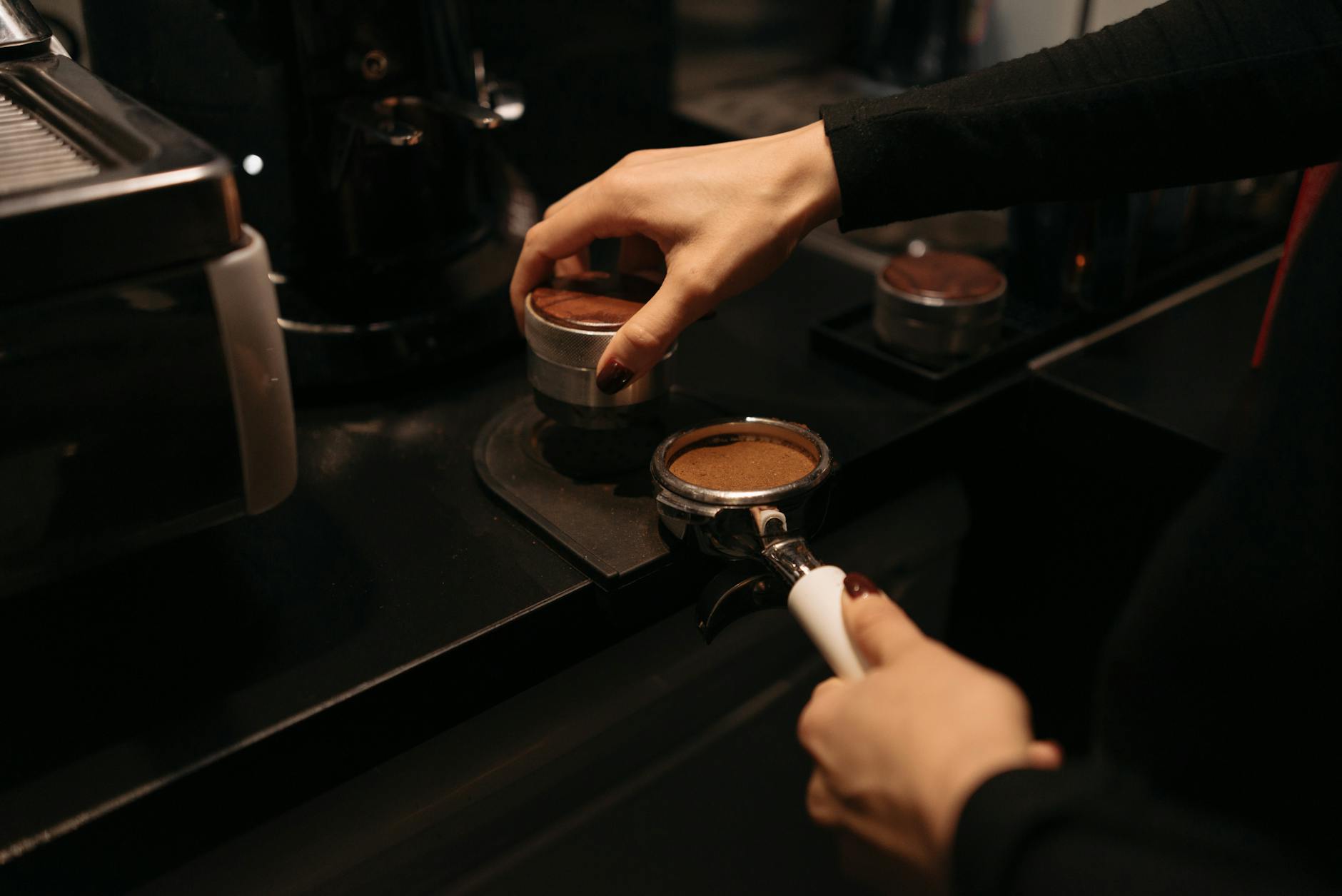
- Grind and prep: Grind your 17g of beans. Your starting grind size should feel slightly finer than table salt. Distribute the grounds evenly in the portafilter to avoid clumps and tamp with firm, level pressure. Consistency is key.
- Pull the shot: Place a scale and a cup under the portafilter. Start a timer the moment you press the brew button. Stop the shot when the scale reads your target yield (34g).
- Analyze the result: Now, look at your time. This tells you what to do next.
- Shot finished in under 25 seconds: Your grind is too coarse. The water flowed through the coffee puck too easily. Make your grind one step finer and try again.
- Shot finished in over 35 seconds: Your grind is too fine. The water struggled to push through the puck. Make your grind one step coarser and try again.
- Shot finished in 25-35 seconds: You’re in the right zone! Now you can taste it. If it’s sour, try a slightly finer grind to extract more. If it’s bitter, try a slightly coarser grind to extract less.
This iterative process of adjusting one variable at a time is the core of making great espresso.
Troubleshooting your shot
| Problem | Likely Cause | Primary Solution |
|---|---|---|
| Shot is too fast (<25s) / Tastes sour | Grind is too coarse | Adjust grinder to be finer |
| Shot is too slow (>35s) / Tastes bitter | Grind is too fine | Adjust grinder to be coarser |
| Shot sprays everywhere (channeling) | Uneven puck preparation | Improve distribution (WDT) and ensure a level tamp |
Beyond the grind: Other variables that matter
While grind size is the most impactful variable, it doesn’t exist in a vacuum. Once you’re in the right ballpark with your grind, tiny adjustments to other factors can elevate your espresso from good to great. If your shots are inconsistent even after finding a good grind setting, one of these other variables might be the culprit.
First is your dose. Changing the amount of coffee in the basket, even by half a gram, will alter the shot’s timing. A larger dose increases the density of the coffee puck, slowing down the shot, while a smaller dose will speed it up. It’s crucial to use a scale to weigh your dose for every single shot to maintain consistency.
Next is puck preparation. An uneven or crooked tamp can create weak spots in the coffee puck where water will rush through, a phenomenon called “channeling.” This leads to a shot that is simultaneously under-extracted (sour) and over-extracted (bitter). Focus on distributing your grounds evenly and tamping level every time.
Finally, consider your beans. Freshly roasted coffee (within 4 weeks of the roast date) behaves very differently from old, stale coffee from the supermarket. Fresh beans contain CO2 which helps in crema formation and provides proper resistance. If you’re using old beans, you may have to grind much finer to slow the shot down, often leading to a bitter taste.
By controlling these variables, you ensure that the changes you make to your grind size have a predictable and repeatable effect on your final cup.
Conclusion
Mastering the grind for your Gaggia Classic Pro is a rewarding journey that transforms you from a coffee drinker into a home barista. The key is to first understand your equipment. The forgiving pressurized basket is perfect for starting out with a coarser grind, but the non-pressurized basket is your ticket to authentic espresso, demanding a fine, uniform grind from a quality burr grinder. The process of dialing in—aiming for a 1:2 ratio in about 25-35 seconds—is a systematic method of tasting and adjusting. By changing one variable at a time, you can methodically zero in on the perfect extraction. Remember that this is a skill built on patience and practice. Don’t be discouraged by a few bad shots. Embrace the process, trust your palate, and soon you’ll be pulling delicious, syrupy espresso that rivals your favorite café.

 No products in the cart.