

Mastering the challenge: How to dial in light roast coffee on an E61
Light roast coffee represents the pinnacle of complexity for many espresso lovers. It promises vibrant, fruity, and floral notes that are simply unattainable with darker roasts. However, anyone who has tried to pull a shot of light roast on a classic E61 group head knows the frustration. Instead of a sweet, balanced cup, you often get a shockingly sour, under-extracted mess. This difficulty stems from the physical nature of lightly roasted beans; they are denser, less soluble, and require a different approach than their darker counterparts. This guide will walk you through the specific techniques and variables you need to control to tame these challenging beans and unlock their incredible flavor potential using your E61 machine.
Understanding why light roasts are different
Before you can adjust your technique, it’s crucial to understand why light roast coffee behaves so differently. During the roasting process, coffee beans lose moisture, expand, and become more brittle and porous. A light roast is stopped early in this process. The result is a bean that is significantly denser and less developed than a medium or dark roast. This density creates two primary challenges for espresso extraction.
First, the bean’s cellular structure is less porous, making it harder for water to penetrate and extract the delicious soluble compounds. This property, known as lower solubility, is the main culprit behind sour shots. Standard espresso parameters (like a 25-second shot at 9 bars) simply don’t provide enough contact time or energy to properly extract a light roast. Second, their density means they shatter into a wider range of particle sizes when ground, creating more fine particles which can easily clog the basket and cause channeling, leading to a shot that is simultaneously sour and bitter.
Leveraging the E61’s inherent strengths
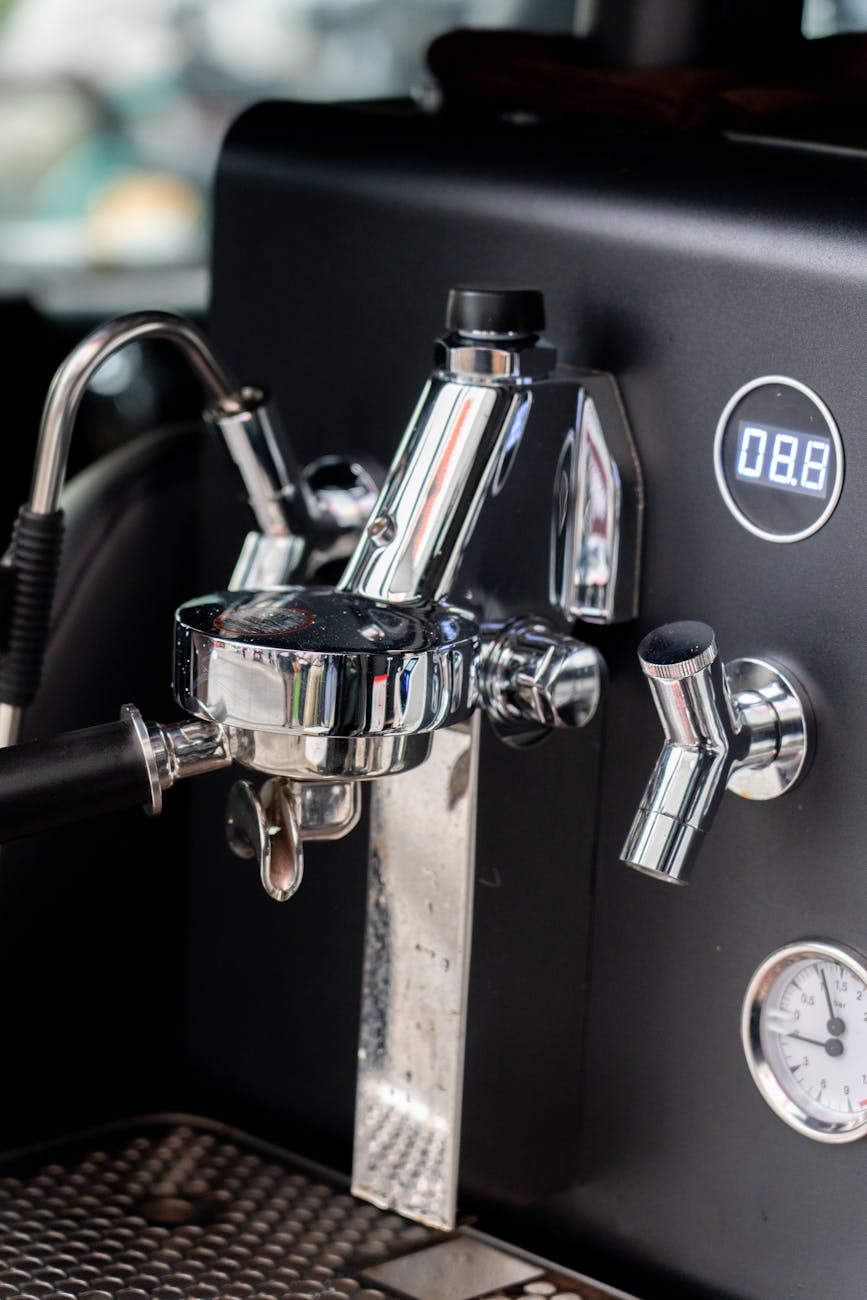
While challenging, the E61 group head has features that, when understood and leveraged correctly, make it an excellent tool for light roasts. Its most famous feature is its sheer mass. The entire group head is a large piece of chrome-plated brass, weighing around 4 kg (9 lbs). This acts as a massive heat sink, providing exceptional thermal stability once it’s fully heated. Light roasts demand higher brew temperatures—often in the 94-96°C (201-205°F) range—to increase solubility. An E61, once properly warmed up for at least 30-45 minutes, can deliver that heat consistently throughout the shot.
The second key feature is its mechanical pre-infusion. When you lift the brew lever, a valve opens that allows water to enter a small chamber within the group head. This process slowly and gently wets the coffee puck at low pressure before the pump engages to deliver the full 9 bars. This gentle saturation is critical for light roasts. It helps settle the coffee bed, reduces the risk of channeling when the high pressure hits, and gives the water a head start on penetrating the dense grounds, leading to a more even and complete extraction.
Advanced techniques for optimal extraction
To truly master light roasts, you need to go beyond the basics and fine-tune your entire process. This starts with your grinder. You will inevitably have to grind finer than you would for a darker roast to increase the coffee’s surface area and slow down the flow of water. However, grinding finer increases the risk of channeling, which makes puck preparation absolutely non-negotiable.
- Puck prep: Using a Weiss Distribution Technique (WDT) tool is essential to break up clumps and create a homogenous, fluffy bed of coffee. This ensures water flows evenly through the entire puck.
- Rethink ratios: The traditional 1:2 brew ratio (e.g., 18g of coffee in, 36g of espresso out) is often too short for light roasts. To extract more sweetness and balance the bright acidity, you need to push the ratio longer. Start with a 1:2.5 ratio and don’t be afraid to go up to 1:3. This means your total shot time will also be longer, often in the 35-45 second range.
- Flow control: The ultimate upgrade for an E61 machine is a flow control device. This modification adds a valve to the group head, allowing you to manually profile the flow rate and pressure of your shot. For a light roast, you can perform a long, low-pressure pre-infusion (e.g., 15-20 seconds at 2-3 bars) to fully saturate the puck, then gently ramp up to a peak pressure of maybe 8 bars, and finally taper the pressure down at the end to avoid extracting harsh flavors.
A sample workflow and how to taste
Let’s put all this theory into a practical starting point. Remember, every coffee is different, so this is a baseline from which you will need to adjust based on taste. The goal is to move away from puckering sourness and towards a vibrant, sweet acidity, like that of a ripe fruit.
Tasting is your most important tool. Don’t just decide if a shot is “good” or “bad.” Analyze it. Is it unpleasantly sour and vegetal? This is under-extracted. You need to extract more, so try grinding finer, increasing the brew temperature, or extending your brew ratio. Is it harsh, dry, and bitter? This is a sign of over-extraction or, more likely, channeling. Check your puck prep meticulously or try grinding slightly coarser to fix the channel before trying to extract more.
| Variable | Starting recommendation |
|---|---|
| Dose | 18 grams |
| Grind | Fine enough to achieve target time |
| Brew temperature | 95°C / 203°F |
| Pre-infusion | 12-15 seconds (native or with flow control at 2-3 bar) |
| Yield (output) | 45 grams (a 1:2.5 ratio) |
| Total shot time | 35-40 seconds (including pre-infusion) |
Dialing in light roast coffee on an E61 is a journey of patience and precision. It requires you to abandon the standard espresso recipes and embrace a more nuanced approach. By understanding the dense nature of the beans, you can see why higher temperatures and longer extraction times are necessary. Your E61 machine is well-equipped for this task, thanks to its exceptional thermal mass and gentle pre-infusion. To truly excel, you must perfect your puck preparation, experiment with longer brew ratios, and consider a flow control device to gain ultimate command over the extraction. The process can be challenging, but the reward—a sweet, complex, and vibrant shot of espresso that showcases the true origin of the coffee—is well worth the effort.
 No products in the cart.