

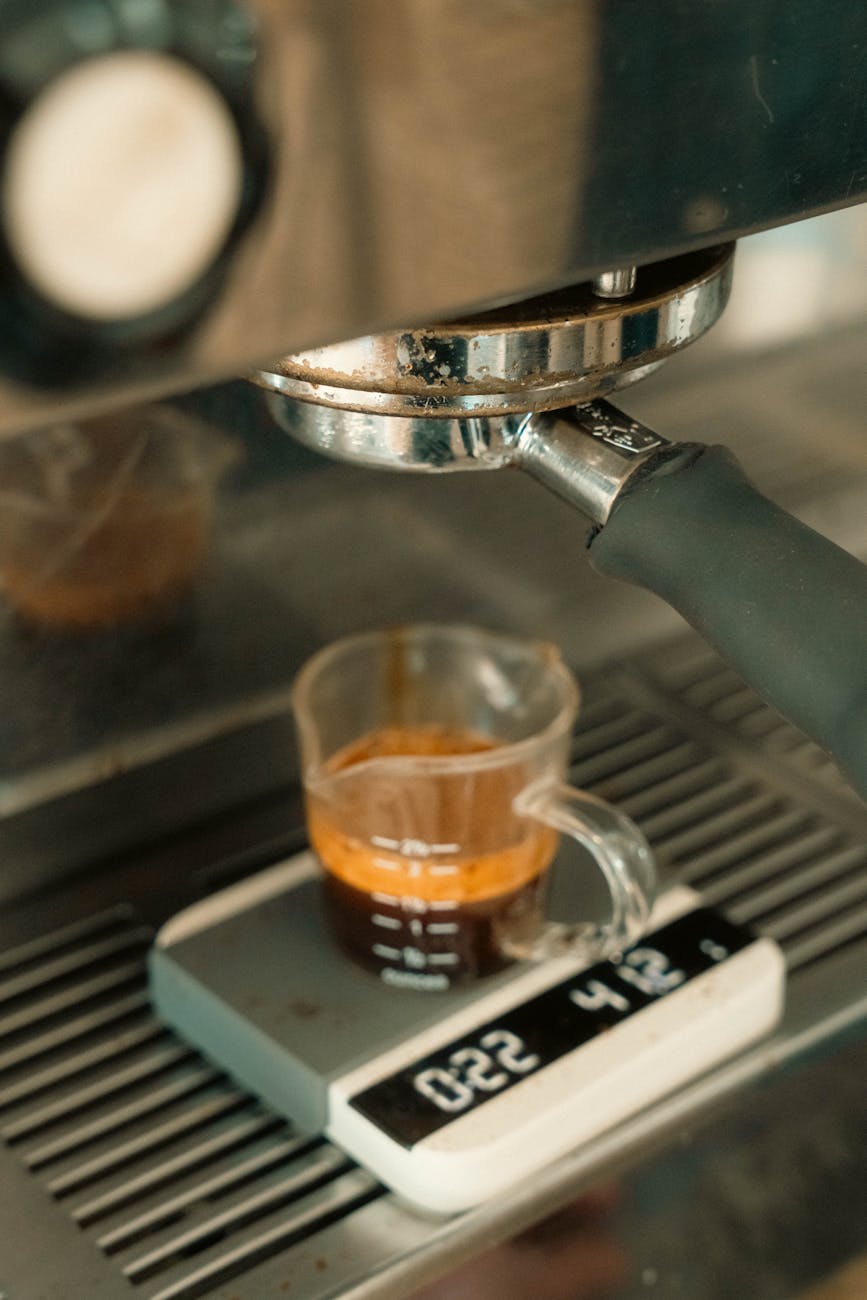
Why your espresso shot time and yield don’t match up
As a home barista, there’s a familiar routine: you prep your puck, lock in the portafilter, and hit the brew button, eyes fixed on the timer. You’re aiming for that magic 27-second shot. The timer hits the mark, you stop the machine, but when you look at your cup, the volume is all wrong. It’s either a thimble-sized, over-concentrated shot or a watery, overflowing mess. This frustrating disconnect between shot time and your final yield is a common hurdle. The truth is, the timer on your machine is often the least reliable metric for pulling a delicious, balanced shot. This article will explore why your stopwatch and your scale tell different stories and guide you toward a more consistent brewing process.
Understanding the real goal of extraction
Before we dive into the technical reasons for the time and yield mismatch, we need to reframe our goal. Many beginners are taught to aim for a shot that runs for 25 to 30 seconds. While this is a helpful starting guideline, it’s not the ultimate objective. The real goal of espresso extraction is to achieve a specific brew ratio, which is the relationship between the dry coffee grounds (your dose) and the liquid espresso in the cup (your yield).
A common starting ratio is 1:2. This means for every 18 grams of dry coffee you put in your portafilter, you want to get approximately 36 grams of liquid espresso out. Time is simply a measurement of how long it took to reach that target yield. It’s a result, not a target itself. If you focus only on time, you ignore the most important factor: how much coffee you’re actually brewing. A 27-second shot that produces 20 grams of espresso and a 27-second shot that produces 50 grams of espresso from the same dose will taste wildly different. The first will likely be sour and under-extracted, while the second will be bitter and over-extracted.
Therefore, the most crucial tool in your arsenal is not a timer, but a coffee scale. By weighing your dose and your yield, you gain precise control over your brew ratio, which is the foundation of a consistent recipe.
The hidden variable: pre-infusion and your timer
One of the biggest culprits behind the time and yield confusion is pre-infusion. This is a short phase at the beginning of the shot where the machine gently soaks the coffee puck with low-pressure water before applying the full nine bars of pressure for extraction. Pre-infusion helps to saturate the grounds evenly, reducing the risk of channeling and leading to a more balanced extraction.
Here’s the problem: most espresso machines start the shot timer the moment you press the brew button. This means the timer is running during the entire pre-infusion phase. If your machine has a 10-second pre-infusion, by the time the timer reads “10”, the full-pressure extraction has only just begun. No significant amount of liquid has reached the cup yet. If you stop the shot when the timer reads “27 seconds”, the coffee has only been extracting at full pressure for 17 seconds. This results in a much smaller yield than you expected for that “full” shot time.
This effect varies greatly between machines:
- E61 Group Heads: These often have a built-in mechanical pre-infusion that can last several seconds.
- Modern Home Machines (e.g., Breville): These have programmable pre-infusion, often set by default to 7-10 seconds.
- Lever Machines: The entire pressure profile is manual, making a simple timer almost irrelevant.
Understanding how your machine works is key. Time your shot from the first drip to get a sense of the “contact time,” but for dialing in, always start your timer when the pump engages for consistency.
How brewing variables change the time and yield relationship
Once you start prioritizing yield over time, you can use time as a diagnostic tool. The flow rate of your shot, and therefore the time it takes to reach your target yield, is directly influenced by several key variables. If your 36-gram yield is coming out in 15 seconds (too fast) or 45 seconds (too slow), you need to adjust one of these factors to get it into the ideal 25-35 second window.
The most important variable you can control is the grind size. This is your primary method for speeding up or slowing down your extraction.
- Shot is too fast (low time for target yield): Your grind is too coarse. The water is flowing through the puck with little resistance. You need to adjust your grinder to a finer setting.
- Shot is too slow (high time for target yield): Your grind is too fine. The water is struggling to get through the tightly packed grounds. You need to adjust your grinder to a coarser setting.
Other factors also play a significant role. Increasing your dose (e.g., from 18g to 19g) will add more coffee to the basket, increasing resistance and slowing down the shot. Conversely, poor puck prep, like uneven tamping, can cause channeling, where water finds a path of least resistance and gushes through, resulting in a very fast, under-extracted shot.
| Variable Adjusted | Effect on Water Flow | Resulting Shot Time (for the same yield) |
|---|---|---|
| Grind made finer | Slower | Longer |
| Grind made coarser | Faster | Shorter |
| Dose increased | Slower | Longer |
| Channeling occurs | Much Faster | Much Shorter |
A new workflow: yield first, time second
To break free from the frustration, you need a new workflow that puts the variables in the correct order of importance. Instead of chasing a number on a timer, follow these steps for a more scientific and repeatable approach to dialing in your espresso.
- Choose your dose and yield: Start with a 1:2 ratio. For example, decide you will use 18 grams of coffee to produce a 36-gram espresso shot. This is your recipe.
- Prepare your shot: Grind your 18-gram dose, prepare your puck, and place your cup on a scale under the portafilter.
- Start brewing and timing simultaneously: Tare the scale, then start both the shot and a separate timer (or the machine’s timer).
- Stop based on yield: Watch the scale, not the timer. As the weight approaches your 36-gram target, stop the shot.
- Assess the time: Now, look at your timer. Did it take 28 seconds? Perfect. Did it take 18 seconds? Your grind is too coarse. Did it take 40 seconds? Your grind is too fine.
- Adjust and repeat: Adjust your grind size accordingly and pull another shot, still aiming for that 36-gram yield. Repeat until you hit your target yield in the 25-35 second range.
Only after you achieve your target yield in your target time should you taste the espresso. If it’s still not right, you can then start adjusting your ratio (e.g., trying a 1:2.2 ratio for 40g yield) to fine-tune the flavor.
Conclusion
In the world of espresso, time is not the goal; it is a symptom. The widespread myth of the “perfect 27-second shot” has caused countless home baristas to focus on the wrong variable, leading to inconsistent and disappointing results. By understanding that your true targets are dose and yield, you can reclaim control over your brewing. Remember that factors like pre-infusion fundamentally alter what the timer on your machine is actually telling you. By shifting your focus from the clock to the scale, you empower yourself to make intentional changes. Use your grind size, dose, and puck prep to control the flow rate, and use time only as a final diagnostic check. This methodical, yield-first approach will transform your espresso-making from a game of chance into a craft of precision.
 No products in the cart.