

Solving the puzzle: Why your Cafelat Robot espresso lacks body and crema
The Cafelat Robot is a marvel of simplicity and engineering, celebrated for its ability to produce pure, unadulterated espresso. Stripped of pumps and electronics, it puts you in complete control of the extraction process. However, this manual control can be a double-edged sword. Many new owners find themselves frustrated, pulling shots that are thin, watery, and topped with a sad, bubbly excuse for crema. If your espresso lacks the rich, syrupy body and a thick, persistent crema you crave, you’re not alone. This guide is designed to help you diagnose the common issues. We’ll move step-by-step through the most critical variables, transforming your disappointing pulls into the delicious, cafe-quality shots the Robot is truly capable of producing.
The foundation: Fresh beans and a proper grind
Before you even touch the Robot’s steel arms, the battle for body and crema is won or lost with your coffee. Espresso extraction is a delicate process, and it all begins with your raw materials. The single most common reason for a lack of crema is stale coffee. Crema is formed when hot, pressurized water emulsifies the oils in the coffee and traps carbon dioxide (CO2) gas. This CO2 is a natural byproduct of the roasting process and dissipates over time. If your beans were roasted months ago, they simply won’t have enough gas left to produce a rich crema, no matter how perfect your technique is. For the best results, always use beans that are between four days and four weeks past their roast date.
Once you have fresh beans, the next critical element is the grind size. The Cafelat Robot requires a fine, consistent espresso grind to build the necessary pressure for a proper extraction. If your shot gushes out in under 15 seconds, your grind is too coarse. This fast flow means the water isn’t spending enough time in contact with the coffee grounds to extract the soluble solids and oils that create body and flavor. Start by grinding finer until your total shot time, including a brief pre-infusion, is in the 25-35 second range. A quality burr grinder is non-negotiable for achieving the fine adjustments needed for great espresso.
Perfecting the puck: Distribution and tamping
With fresh beans and the right grind size, your focus shifts to how you prepare the coffee in the portafilter basket. An evenly prepared puck is essential for preventing a phenomenon called channeling. Channeling occurs when water finds a path of least resistance through the coffee bed, leading to uneven extraction. Some parts of the coffee will be over-extracted (bitter), while others are under-extracted (sour and weak), resulting in a thin, disappointing shot.
To combat this, focus on two key steps:
- Distribution: After grinding your coffee into the basket, the grounds will be clumpy and unevenly distributed. Simply tamping this mound will create dense and loose spots. The best practice is to use a Weiss Distribution Technique (WDT) tool—essentially a set of fine needles—to break up clumps and evenly distribute the grounds. This creates a homogenous bed for water to flow through uniformly.
- Tamping: The goal of tamping is not to press as hard as you can, but to create a level and consistently compacted puck. For the Robot, a firm, level tamp is all that’s needed. An uneven tamp will encourage channeling just as much as poor distribution. Use your fingers to feel the rim of the tamper relative to the basket to ensure it’s perfectly flat before applying pressure.
A perfectly prepared puck provides the uniform resistance needed for the next, more hands-on, stage of the process.
Mastering temperature and manual pressure
This is where the manual nature of the Robot truly shines, but it also introduces critical variables you must control. The Robot has no internal heating element, so water temperature management is entirely up to you. Brewing with water that isn’t hot enough is a common cause of sour, thin-bodied espresso. To ensure proper extraction temperature, you must preheat the components. The most effective method is to place the piston in a cup and pour boiling water over it, while also filling the basket with hot water before you dose your coffee. For most medium-to-dark roasts, using water straight off the boil is a great starting point, as it will cool slightly upon contact with the machine.
Next is pressure. Unlike a semi-automatic machine with a fixed pressure profile, you are the pump. A lack of body can often be traced to insufficient pressure or a poorly executed pressure profile. A great shot on the Robot typically involves three phases:
- Pre-infusion: Gently lift the arms until you see the first few drops appear at the bottom of the basket. Hold this low pressure (1-2 bars) for 5-10 seconds. This gently saturates the puck and helps prevent channeling when you apply full pressure.
- Ramping and holding: Smoothly and firmly press the arms down to achieve your target pressure, typically between 6 and 9 bars. You’ll need to apply significant force here. Hold this pressure as consistently as you can.
- Declining pressure: As the shot progresses, you can allow the pressure to naturally decline towards the end of the shot, which can result in a softer, more balanced extraction.
If you apply too little pressure or rush the shot, you simply won’t extract the necessary compounds for a full-bodied espresso.
Dialing in your recipe: Dose and ratio
Finally, let’s tie it all together with a repeatable recipe. The amount of coffee you use (your dose) and the amount of liquid espresso you produce (your yield) are fundamental to the final taste and texture. This is known as your brew ratio. A common mistake is under-dosing the basket, which can make it difficult to build adequate pressure and often leads to a fast, watery shot. For a standard Robot basket, a dose between 16 and 18 grams is a solid starting point.
The brew ratio directly impacts the body of your espresso. A standard starting point for a balanced shot is a 1:2 ratio. This means for every 1 gram of coffee grounds, you aim for 2 grams of liquid espresso in your cup. For an 18-gram dose, your target yield would be 36 grams.
- If you want a thicker, more syrupy shot with intense body, try a tighter ratio like a ristretto (1:1.5), yielding around 27 grams.
- If you are pulling a much longer ratio, like a lungo (1:3 or more), your shot will naturally be thinner and have less body.
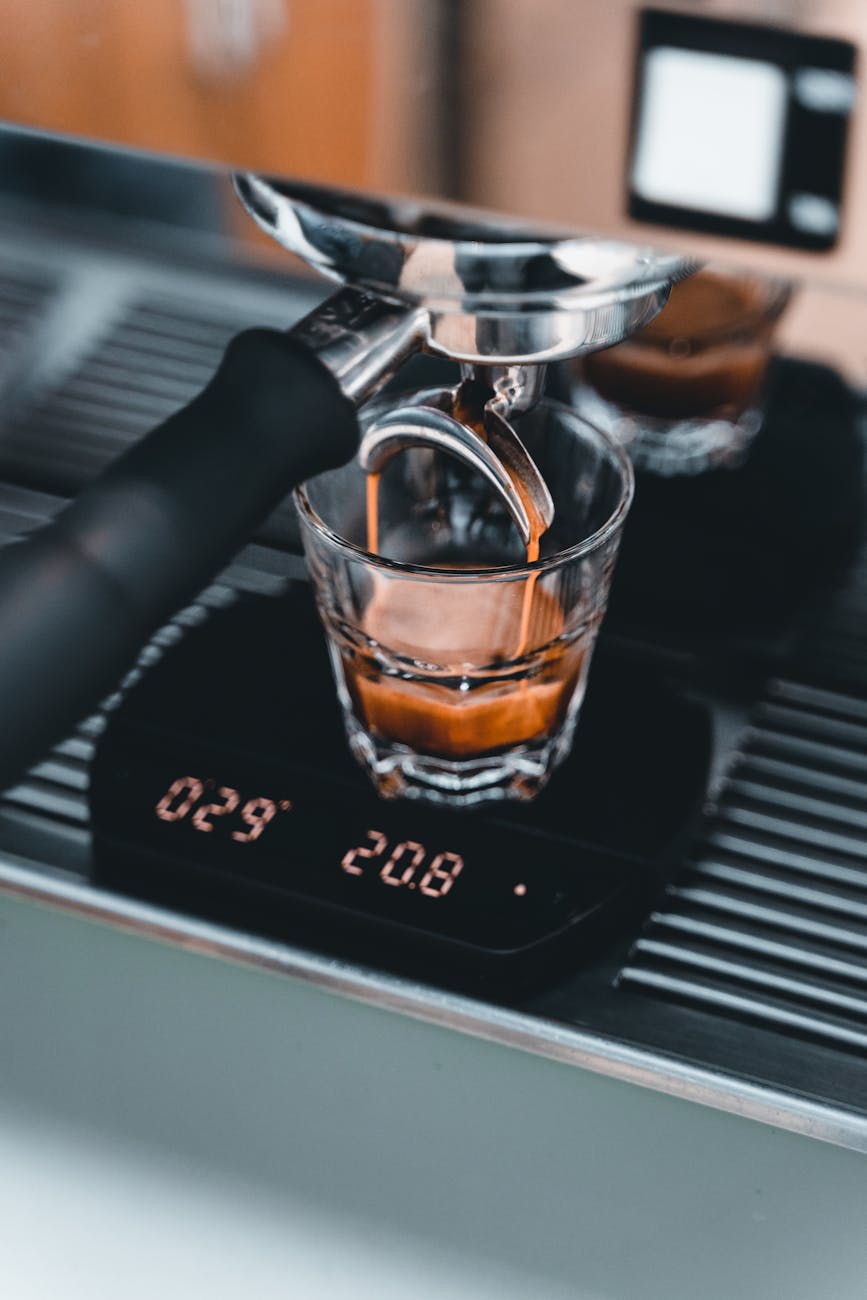
Using a small scale to weigh your dose and your yield is the most effective way to achieve consistency and make targeted adjustments. Below is a table summarizing common issues and their solutions.
| Problem | Potential Cause(s) | Solution(s) |
|---|---|---|
| No Crema / Thin Crema | Stale coffee beans Grind is too coarse Water is not hot enough |
Use beans roasted within the last 2-4 weeks. Grind finer until shot time is 25-35 seconds. Preheat the piston and basket; use boiling water. |
| Watery Body / Thin Taste | Brew ratio is too high (Lungo) Channeling in the puck Insufficient pressure or pre-infusion |
Aim for a 1:2 ratio (e.g., 18g in, 36g out). Use a WDT tool for even distribution; ensure a level tamp. Apply firm, consistent pressure (6-9 bars) after a 5-10 second pre-infusion. |
Conclusion
Achieving a rich, crema-topped espresso with a full, syrupy body from your Cafelat Robot is not a matter of luck, but a result of a methodical process. As we’ve explored, the journey begins with the very foundation of your shot: incredibly fresh beans and a fine, consistent grind. From there, meticulous puck preparation using tools like a WDT prevents channeling, ensuring an even extraction. You must also take active control of your variables, preheating the machine to manage temperature and learning to apply a deliberate pressure profile with a proper pre-infusion. Finally, using a scale to control your dose and brew ratio gives you the power to dictate the final texture of your espresso. By patiently addressing each of these elements one at a time, you will unlock the Cafelat Robot’s true potential and be rewarded with exceptional espresso every single time.
 No products in the cart.