

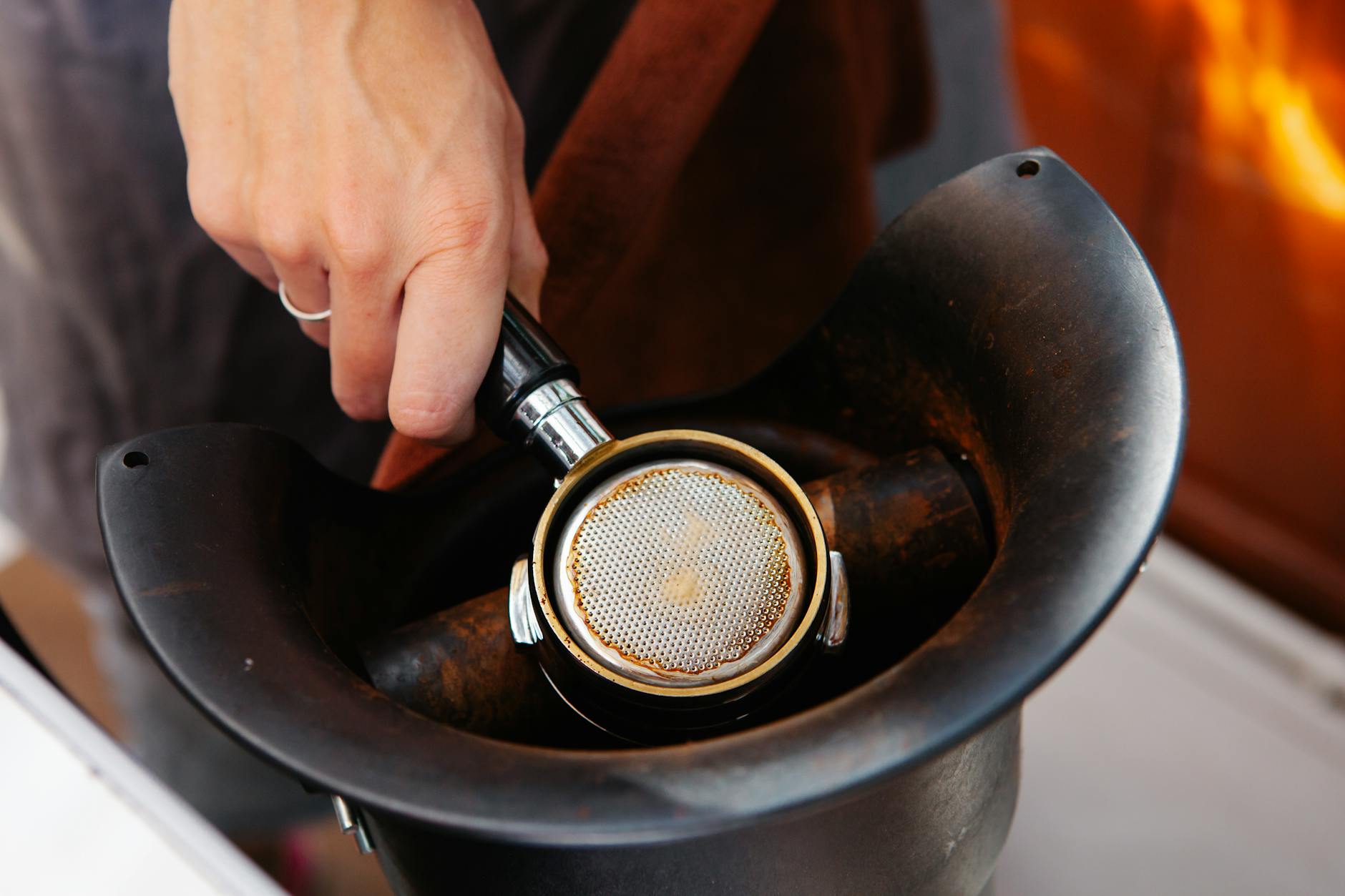
Why puck prep is more critical on manual espresso machines
There’s a certain romance to manual espresso machines. The gleaming lever, the quiet operation, and the direct, tactile connection to the coffee-making process appeal to enthusiasts seeking ultimate control. Unlike their semi-automatic cousins, these machines have no internal pump or complex electronics; the barista provides the pressure. This complete control is both their greatest strength and their most demanding characteristic. While preparing the coffee puck is important for any espresso, on a manual machine, it transforms from a simple step into the absolute cornerstone of a successful shot. Flaws that a semi-automatic machine might forgive are brutally exposed by a manual lever, making meticulous puck prep not just best practice, but an essential skill for avoiding frustration.
You are the pump: The unforgiving nature of manual control
On a semi-automatic espresso machine, you push a button, and an electric pump engages, forcing water through the coffee grounds at a consistent, regulated pressure, typically around 9 bars. This system creates a relatively stable environment for extraction. The constant pressure can, to some extent, power through minor imperfections in the coffee puck, like a small clump or a slightly uneven surface. It acts as a safety net, masking small errors.
A manual machine has no such safety net. You are the pump. The force you apply to the lever is transferred directly to the water and onto the puck. This means any inconsistency, any weak spot, or any channel in the coffee bed will be immediately felt. Instead of building resistance, the lever will suddenly give way, offering a clear, tactile signal that the extraction has failed. There is no regulated pressure to mask the problem; the puck’s integrity is the only thing creating resistance. This direct feedback is what makes manual machines such great learning tools, but it’s also what makes them so demanding of perfect preparation.
| Puck prep step | Impact on a semi-automatic machine | Impact on a manual machine |
|---|---|---|
| Uneven distribution | May cause some channeling, but the pump’s steady pressure can sometimes mitigate the effect, leading to a merely “okay” shot. | Causes immediate, noticeable channeling. The lever will offer no resistance as water bypasses the coffee, ruining the shot. |
| Clumpy grounds | Can lead to an uneven shot as water flows around clumps, but the machine might still produce a drinkable result. | Creates pockets of dry coffee and massive weak spots. Guaranteed to cause major channeling and a failed extraction. |
| Tilted tamp | Water will favor the lower side, causing an unbalanced extraction with both sour and bitter notes. | A catastrophic failure. Water will gush through the low side, no pressure can be built, and the shot is unsalvageable. |
Channeling, the arch-nemesis of manual espresso
To understand why puck prep is so vital, we must talk about its greatest enemy: channeling. Channeling occurs when water finds a path of least resistance through the coffee puck instead of flowing evenly through all the grounds. Imagine a river finding a crack in a dam; it will exploit that weakness and gush through, ignoring everything else. In espresso, this means some parts of the coffee are completely bypassed (under-extracted and sour), while the coffee along the channel is blasted with water (over-extracted and bitter). The result is a thin, messy, and terrible-tasting shot.
On a manual machine, channeling isn’t just a flavor defect; it’s a complete mechanical failure. As soon as a channel forms, the resistance you were building with the lever vanishes. The shot “blondes” instantly, and you’ll often see jets of watery coffee spraying from the bottom of your portafilter. Because you are manually applying pressure, you can’t simply “push through” it. The shot is over. This immediate and dramatic failure is a direct consequence of the physics involved and highlights how the structural integrity of the puck is paramount.
Building the foundation: The non-negotiable prep workflow
Given the unforgiving nature of manual machines, a consistent and meticulous puck prep workflow is not optional. It is the only way to reliably build the resistance needed for a proper extraction. This process involves a few key steps that work together to create a homogenous and structurally sound coffee bed.
- Dose with precision: Start by weighing your coffee beans to within 0.1 grams. A consistent dose ensures that you have the same amount of coffee to work with every single time, which is the first step toward a repeatable shot.
- Distribute for uniformity (WDT): This is arguably the most important step for manual espresso. Using a Weiss Distribution Technique (WDT) tool, which consists of several fine needles, you stir the grounds in the portafilter. This action breaks up any clumps from the grinder and evenly distributes the coffee particles, eliminating low-density areas that could become channels.
- Tamp for a level bed: The goal of tamping is not to press as hard as you can, but to create a perfectly level and evenly compressed surface. A level tamp ensures that when water is introduced, it saturates the entire surface of the puck at the same time. An unlevel tamp provides an engraved invitation for water to start channeling down the lower side.
Mastering these three steps creates a puck that is strong enough to withstand the pressure you apply, allowing for a beautiful, even, and delicious extraction.
Unlocking artistry: Puck prep as a gateway to advanced techniques
Here’s the beautiful part: mastering puck prep doesn’t just help you avoid bad shots; it unlocks the true potential of your manual machine. The unique advantage of a lever machine is the ability to manipulate pressure and flow throughout the shot, a technique known as pressure profiling.
With a perfectly prepared, structurally sound puck, you can perform techniques impossible on most entry-level semi-automatics. You can begin with a long, low-pressure pre-infusion, gently saturating the entire coffee bed without disturbing it. This swells the grounds and helps ensure a more even extraction once you ramp up the pressure. After pre-infusion, you can apply full pressure and then gently taper it off toward the end of the shot to reduce bitterness and highlight sweetness. This level of artistry and control is the very reason to own a manual machine. However, none of it is possible with a flawed puck. Attempting a long pre-infusion on a poorly distributed puck will simply cause it to fall apart before you even begin the main extraction.
Conclusion
In the world of manual espresso, the user is an integral part of the machine’s mechanics. This direct involvement means there is nowhere for preparation errors to hide. While a semi-automatic machine’s pump can sometimes mask minor flaws, a manual lever will expose every clump and every uneven patch with immediate, unforgiving feedback. Channeling goes from being a minor issue to a catastrophic failure. Therefore, a meticulous workflow—precise dosing, thorough distribution with a WDT tool, and a level tamp—is not just a recommendation; it is a fundamental requirement. By embracing this precision, you move beyond merely preventing failure. You build the solid foundation required to explore the artistic potential of your machine, mastering pre-infusion and pressure profiling to craft shots of espresso with unparalleled quality and nuance.
 No products in the cart.