

The Olympia Cremina is more than just an espresso machine; it’s a piece of coffee history and a testament to the art of manual extraction. For its devotees, the allure lies not in its simplicity, but in the profound control it offers. Unlike semi-automatic machines that manage pressure for you, the Cremina places the entire process directly in your hands. The force you apply to the lever dictates the pressure inside the grouphead, creating a unique pressure curve for every single shot. Understanding and manipulating this curve is the key to unlocking the Cremina’s legendary potential. This article will guide you through the intricacies of the Cremina’s pressure curve, from the foundational stages to advanced techniques for tailoring your shot to any coffee bean.
What is a pressure curve?
In the world of espresso, a pressure curve, or pressure profile, is a graph of the pressure applied to the coffee puck over the duration of the shot. While a standard pump machine might aim for a flat 9 bars of pressure, a manual lever machine like the Cremina allows for a dynamic and nuanced approach. This control is critical because different stages of extraction benefit from different levels of pressure. A well-executed pressure curve doesn’t just push water through coffee; it coaxes out flavour, balances acidity, and builds texture.
A typical espresso shot, whether manual or automatic, can be broken down into three main phases, each with its own pressure goal:
- Pre-infusion: This is the initial stage where water at low pressure (typically 1-3 bars) gently saturates the coffee puck. This allows the coffee to swell and degas, which helps prevent channeling (when water finds a path of least resistance) and promotes a more even extraction.
- Peak extraction: Following pre-infusion, the pressure is ramped up to its target, often between 6 and 9 bars. This is the main phase of the shot where the majority of the oils, sugars, and flavour compounds are extracted, creating the body and crema of the espresso.
- Ramp-down: In the final stage of the shot, the pressure gradually declines. This gentle finish helps to reduce the extraction of bitter compounds that tend to be released towards the end, resulting in a cleaner and sweeter cup.
With the Cremina, you are not a button-pusher; you are the architect of this entire process. The speed at which you lower the lever and the force you apply directly shapes this curve.
The classic Cremina profile
While the possibilities are endless, there is a “classic” pressure profile that serves as an excellent starting point and works wonderfully for a wide range of medium roast coffees. This profile naturally mimics what many high-end modern machines try to replicate electronically. It’s a graceful, declining curve that highlights sweetness and body.
Here’s how it unfolds:
- Gentle pre-infusion: After locking in the portafilter, you lift the lever. This action draws hot water from the boiler and into the grouphead, filling the space above the coffee puck. The pressure at this stage is very low, usually just the 1-2 bars of “line pressure” created by the steam in the boiler. You hold it here for about 5-10 seconds, watching for the first few drops of espresso to appear at the bottom of the basket. This is your visual cue that the puck is fully saturated.
- The initial pull: Now, you begin to apply downward force on the lever. You’ll want to ramp up the pressure smoothly but firmly until you reach your peak target. For this classic profile, aiming for around 8-9 bars is ideal. You can feel the resistance of the puck as you push; a smooth, steady resistance is a sign of good puck preparation.
- The declining peak: You don’t hold this peak pressure in a static way. The goal is to maintain significant pressure for the first half to two-thirds of the shot volume. As you pull, you’ll naturally ease off the force, allowing the pressure to slowly decline from its 9-bar peak down to around 6 bars or even lower by the end of the shot. This declining pressure is a hallmark of lever machines and is key to avoiding over-extraction and bitterness in the final moments of the pull.
Mastering this classic curve provides the foundation upon which all other profiles are built. It teaches you to feel the feedback from the puck and connect your physical input to the flavour in the cup.
Manipulating the curve for different beans
The true magic of the Cremina is its ability to adapt. Not all coffees are the same; a light roast from Ethiopia requires a different approach than a dark, chocolatey Brazilian blend. By altering your pressure curve, you can create the ideal extraction environment for any bean.
For light roasts: These beans are denser and less soluble. To extract their bright, floral, and acidic notes without sourness, you need to give the water more time and energy to work.
- Extended pre-infusion: Hold the pre-infusion phase for longer, perhaps 12-15 seconds, to ensure the dense puck is fully saturated.
- Higher peak pressure: A full 9 bars of pressure can help break down the bean’s cellular structure to release its complex flavours.
- Slow ramp-down: Maintain a higher pressure for longer before allowing it to taper off, ensuring you achieve a full extraction.
For dark roasts: These beans are more brittle, porous, and highly soluble. The goal here is to extract their deep, sweet, and rich flavours without pulling out the ashy, bitter compounds that can easily emerge.
- Short pre-infusion: A quick pre-infusion of 4-6 seconds is often enough. Too long, and you might start extracting unpleasant flavours before the main pull even begins.
- Lower peak pressure: Aiming for a peak of 6-7 bars is often ideal. This gentler pressure is less likely to fracture the brittle coffee grounds and cause channeling, leading to a smoother, less bitter shot.
- Quicker ramp-down: A faster decline in pressure helps to end the extraction cleanly, preserving the coffee’s sweetness and body.
Here is a simple table to summarize these approaches:
| Bean characteristic | Pre-infusion | Peak pressure | Profile focus |
|---|---|---|---|
| Light roast (Dense, less soluble) | Long (10-15s) | High (8-9 bars) | Maximize extraction of delicate, acidic notes. |
| Medium roast (Balanced) | Standard (8-10s) | Standard (8-9 bars) | Classic declining profile for balance and sweetness. |
| Dark roast (Brittle, more soluble) | Short (4-6s) | Low (6-7 bars) | Avoid bitterness, emphasize body and sweetness. |
Tools for feeling the pressure
While much of the Cremina experience is based on feel, a few tools can help you translate that feeling into measurable data, leading to greater consistency. Puck preparation is paramount—a quality grinder, a WDT tool to break up clumps, and a consistent tamp create a puck that can withstand pressure evenly. Beyond that, you can measure the pressure itself.
A simple method is to place the Cremina on a bathroom scale. By taring the scale with the machine on it, you can measure the downward force you apply in pounds or kilograms. With a bit of math (the Cremina’s piston has an area of roughly 11.34 cm²), you can convert this force into bars of pressure. For example, applying about 90 kg of force will result in approximately 8 bars of pressure on the puck. This is a great training tool for calibrating your arm.
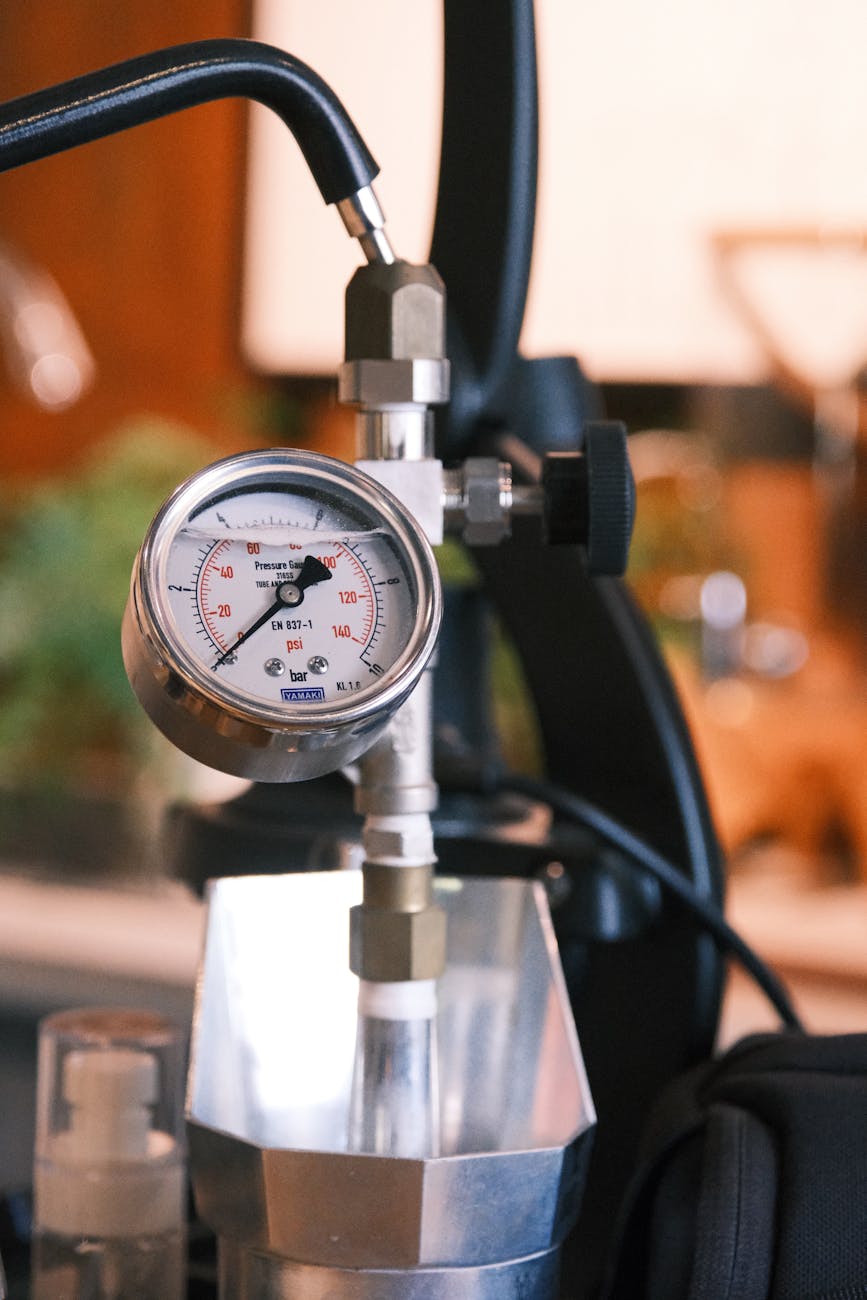
For more precise, real-time feedback, you can invest in a pressure gauge kit. Companies offer specialized kits that replace the piston shaft or attach to a bottomless portafilter, displaying the exact pressure inside the grouphead throughout the shot. This visual feedback is invaluable for learning to replicate profiles and for diagnosing any issues in your technique.
Mastering the pressure curve on an Olympia Cremina is a journey that elevates coffee making from a routine to a craft. We’ve explored how the curve is composed of pre-infusion, peak extraction, and a declining ramp-down, each phase playing a crucial role in the final taste. The classic declining profile serves as a brilliant starting point, but the true artistry lies in adapting your technique. By tailoring the length of pre-infusion and the peak pressure, you can accentuate the bright florals of a light roast or the deep chocolate notes of a dark roast. Using tools like a scale or a pressure gauge can build consistency, but ultimately, the machine teaches you to trust your senses. This hands-on process is what makes the Cremina so special, turning every espresso into a unique creation.

 No products in the cart.