

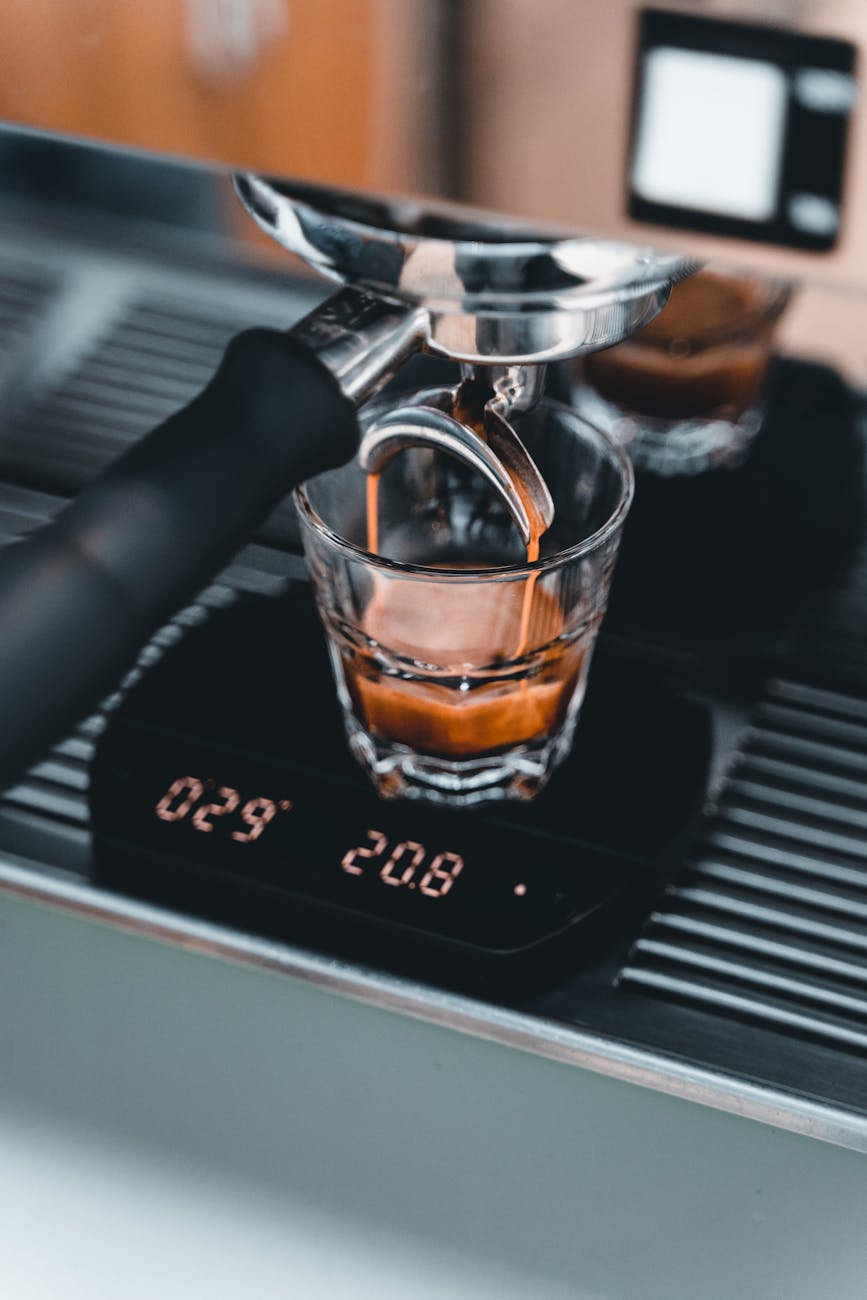
How to fit a coffee scale and a large mug under your Gaggia portafilter
The Gaggia Classic Pro is a legendary machine, a gateway for countless coffee lovers into the world of authentic home espresso. It’s a workhorse known for its power and simplicity. However, it has one well-known quirk that can quickly become a point of frustration: the tight space between the portafilter spouts and the drip tray. If you’re serious about improving your espresso, you know that weighing your shot is non-negotiable. But how can you possibly fit a scale and your favorite latte mug in that tiny gap? It seems impossible. This article is your definitive guide to solving this classic Gaggia problem, transforming your workflow from cramped and frustrating to spacious and precise.
The challenge of vertical space
Before we dive into the solutions, it’s important to understand why this is such a common issue. The Gaggia Classic Pro is designed to be a compact, home-friendly machine. This design philosophy leads to a shorter distance between the group head (where you lock in the portafilter) and the drip tray. With the stock double-spouted portafilter and the standard drip tray, you’re left with only about 8.5 centimeters (or 3.3 inches) of clearance. A standard cappuccino cup might just squeeze in, but a larger mug for an Americano or a latte? Forget about it.
This becomes a real problem when you introduce the most critical tool for consistency: a coffee scale. To achieve repeatable, delicious espresso, you must brew by ratio. This means controlling the ratio of dry coffee grounds in your basket to the liquid espresso in your cup. A common ratio for a modern espresso might be 1:2, meaning 18 grams of coffee grounds should yield 36 grams of liquid espresso. Without a scale under your cup to measure the output in real-time, you’re just guessing. This lack of space forces awkward workarounds, like brewing into a small shot glass and then transferring it, which is messy and causes your espresso to lose precious heat.
Your first upgrades: A bottomless portafilter and a slim scale
The first and most impactful steps you can take involve changing two key pieces of your equipment. These upgrades work together to immediately claw back some much-needed vertical real estate.
First is the bottomless portafilter, often called a “naked” portafilter. As the name suggests, it has no bottom and no spouts. The coffee flows directly from the basket into your cup. This simple change instantly gives you about an extra inch of clearance. But the benefits don’t stop there. A bottomless portafilter is also an invaluable diagnostic tool. It allows you to see your extraction in real-time. If your coffee puck is poorly prepared (a technique known as puck prep), you’ll see jets of water squirting out or uneven flow, a phenomenon called channeling. This visual feedback is crucial for learning to dial in your grinder and improve your tamping technique.
The second piece of the puzzle is a low-profile espresso scale. Your standard kitchen scale is likely too thick and slow for this job. You need a specialized scale with a few key features:
- Slim design: Look for scales that are 2cm (0.8 inches) thick or less.
- Fast response time: It needs to register the weight of the liquid espresso instantly so you can stop the shot accurately.
- Built-in timer: Timing your shot is as important as weighing it, and having a timer on the scale simplifies your workflow.
- Water resistance: Spills happen. A water-resistant scale will survive the inevitable drips and splashes of an espresso machine.
The ultimate fix: A low-profile drip tray
While a bottomless portafilter and a slim scale help immensely, the single biggest improvement you can make is to replace the stock Gaggia drip tray. The original tray is quite deep to hold a decent amount of wastewater, but this depth is what eats up most of your vertical space. The aftermarket community has created a brilliant solution: the low-profile drip tray.
These trays are significantly shorter, instantly adding several centimeters of clearance. They are the key to comfortably fitting a large mug and a scale with room to spare. They generally come in two varieties:
- 3D-Printed Trays: Often found on platforms like Etsy, these are an affordable and popular option. They are lightweight and come in various designs, some with added features like a holder for the water tank hose. The primary downside is that the plastic finish might not feel as premium as the rest of the machine.
- Stainless Steel Trays: Companies like Shades of Coffee offer custom-made stainless steel trays. These are a more premium option, perfectly matching the Gaggia’s aesthetic and offering superior durability. They are more expensive but are a buy-it-for-life upgrade.
The one trade-off with any low-profile drip tray is a reduced water capacity. You’ll need to empty it more frequently, perhaps after every few shots. However, for most users, this is a tiny inconvenience compared to the massive benefit of a functional and spacious workspace.
Comparing clearance solutions
| Setup | Approx. Clearance Gained | Primary Benefit | Consideration |
|---|---|---|---|
| Stock Setup | N/A (Baseline) | Included with machine | Very limited space |
| Bottomless Portafilter | ~2.5 cm / 1 inch | Diagnostic feedback, more space | Requires good puck prep |
| Low-Profile Scale | ~1-2 cm / 0.5 inches | Enables brewing by weight | A necessary purchase for precision |
| Low-Profile Drip Tray | ~4-5 cm / 1.5-2 inches | Maximum space creation | Requires more frequent emptying |
Putting it all together for the perfect workflow
Once you’ve made these upgrades, your daily espresso routine becomes a joy. Gone are the days of balancing cups and guessing your yield. Your new, optimized workflow will look something like this:
- Place your new low-profile drip tray in the machine.
- Put your slim espresso scale on the tray, followed by your favorite large mug.
- Tare the scale so it reads zero.
- Lock your prepared bottomless portafilter into the group head.
- Start your shot and the timer on your scale simultaneously.
- Watch the beautiful, syrupy stream of espresso form in the center of your basket and fall into the mug. Monitor the scale’s display.
- As the weight approaches your target (e.g., 36 grams), stop the pump. Aim to stop it 1-2 grams early, as a few final drips will always fall into the cup.
This seamless process allows you to brew directly into the vessel you’ll be drinking from, whether it’s for a straight shot, an Americano, or a latte. You have achieved espresso nirvana: precision, consistency, and convenience, all without compromise.
In conclusion, the Gaggia Classic Pro’s limited clearance is not a deal-breaker but rather an invitation to improve and customize your machine. While it may seem like a design flaw, it’s a problem that is easily and effectively solved. By strategically combining a bottomless portafilter for initial gains and diagnostic feedback, a slim coffee scale for precision, and a low-profile drip tray for maximum space, you completely transform the machine’s usability. This trifecta of upgrades elevates your Gaggia from a capable entry-level machine into a highly efficient and professional-feeling setup. You no longer have to choose between weighing your shots and using the mug you love; you can finally, and easily, do both.


 No products in the cart.