

The world of home espresso has been revolutionized by a community-driven project known as Gaggiuino. This open-source modification transforms entry-level machines, like the Gaggia Classic Pro, into powerhouses capable of feats once reserved for commercial equipment costing thousands of dollars. The most significant of these is the ability to perform complex pressure and flow profiling. But how does a collection of affordable electronics actually replicate the sophisticated performance of a La Marzocco or Slayer? This article will delve into the specific hardware that Gaggiuino employs, explaining how these components work in concert to create a precise feedback loop that puts the user in complete control of their espresso extraction, simulating the most sought-after commercial profiles right on their kitchen counter.
What is espresso profiling?
Before diving into the hardware, it’s crucial to understand what we mean by “profiling.” In espresso, profiling refers to the deliberate manipulation of variables like pressure and flow rate throughout the duration of a shot. Traditional home machines are simple; they switch the pump on, and it ramps up to a static pressure (usually 9-10 bar) until the user switches it off. High-end commercial machines, however, offer granular control.
Pressure profiling involves changing the pressure exerted on the coffee puck at different stages. A shot might start with a low-pressure “pre-infusion” to gently saturate the grounds, ramp up to a peak pressure for the main extraction, and then taper off to reduce the chance of channeling and bitterness.
Flow profiling is a related concept that focuses on controlling the volume of water moving through the coffee puck per second. Machines like the Slayer are famous for their extremely low-flow pre-infusion, which can dramatically alter the taste and texture of the final cup. By controlling these variables, a barista can highlight specific flavors, enhance sweetness, and improve the overall balance of an espresso shot.
The Gaggiuino hardware ecosystem
The magic of Gaggiuino lies in its ability to create a smart, responsive system from relatively simple parts. It essentially adds a brain, senses, and fine motor control to a machine that was originally just a simple on/off appliance. The core components are:
- The brain: At the heart of the system is a microcontroller, typically an Arduino Nano or a more powerful STM32 “Black Pill.” This tiny computer runs the Gaggiuino software. It reads data from the sensors, compares it to the user’s desired profile, and sends commands to control the pump.
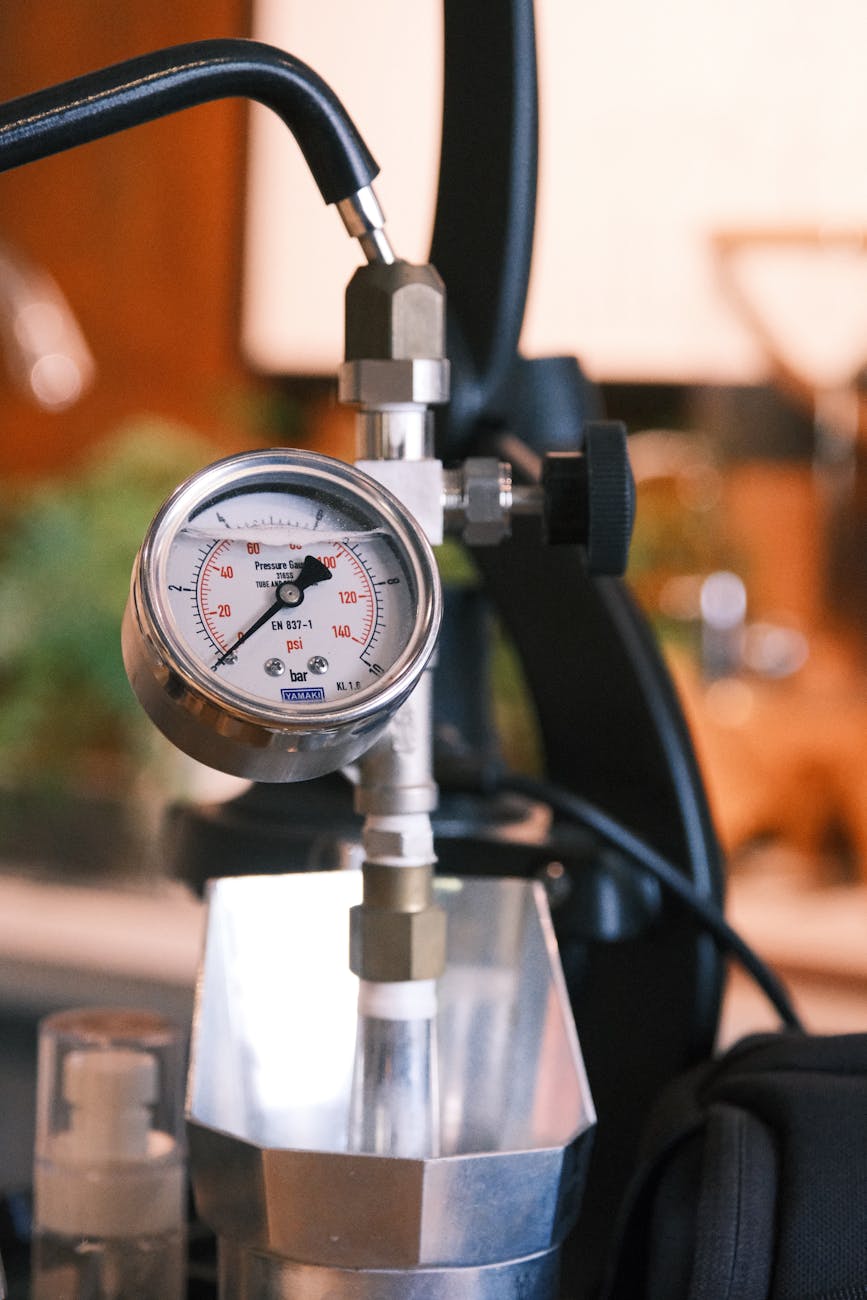
- The senses: To know what’s happening inside the machine, Gaggiuino needs sensors. The most important is a pressure transducer, which is plumbed into the boiler or group head. It constantly measures the brew pressure and sends this data back to the microcontroller as an electrical signal. For flow profiling, the system integrates with bluetooth-enabled scales (like certain Acaia or Felicita models) to measure the real-time weight of the espresso in the cup, thereby calculating the flow rate.
- The muscle: A standard espresso machine’s vibration pump is not designed for variable power. Gaggiuino solves this by using a dimmer module or a Solid-State Relay (SSR) wired for phase-angle control. This component sits between the machine’s power and the pump, allowing the microcontroller to precisely adjust the voltage going to the pump. Lower voltage means lower pump power and, consequently, lower pressure and flow.
- The interface: To allow the user to select profiles and see real-time data, the system includes a small OLED screen and a rotary encoder knob. This lets the user see a live graph of the pressure and flow during the shot.
From data to action: The feedback control loop
The individual hardware components are impressive, but their true power is unlocked when they work together in a feedback loop. This process is a classic example of a PID (Proportional-Integral-Derivative) control system, which happens hundreds of times per second.
Here’s how it works during a shot:
- The user selects a pre-programmed pressure profile, for example, one that calls for 3 bars of pressure for the first 10 seconds.
- The microcontroller turns the pump on at a low power setting via the dimmer module.
- The pressure transducer instantly reads the actual pressure in the system and sends this data back to the microcontroller.
- The microcontroller compares the actual pressure to the target pressure (3 bar). This difference is called the “error.”
- The PID algorithm calculates the necessary adjustment. If the pressure is too low, it tells the dimmer to send a little more power to the pump. If it’s too high, it reduces the power.
- This cycle of measure, compare, adjust repeats continuously, allowing the Gaggiuino to precisely track the target profile, making micro-adjustments to keep the pressure exactly where it needs to be. The same logic applies to flow-based profiles using data from the scales.
Simulating classic commercial profiles
With this sophisticated control system, a Gaggiuino-modified machine can accurately replicate the signature shot styles of iconic commercial machines. The combination of precise sensors and fast power adjustment makes these complex profiles possible.
| Profile Type | Description of the Profile | Key Gaggiuino Hardware in Action |
|---|---|---|
| Slayer-style shot | A very long, low-pressure and low-flow pre-infusion (e.g., 3 bar for 30 seconds) followed by a ramp up to full 9-bar pressure. This is known for producing sweet, syrupy shots. | The dimmer holds the pump at a very low power setting, while the pressure transducer confirms the pressure stays at the low target. The system waits for a set time or for the first drops to hit the cup (detected by the scales) before ramping up. |
| Lever machine profile | This profile mimics a manual lever machine, starting at a high pressure (around 9 bar) and then naturally declining over the course of the shot (e.g., down to 6 bar). This can reduce bitterness in the final part of the extraction. | The microcontroller follows a programmed curve, using the PID loop to gradually command the dimmer to reduce pump power, ensuring a smooth and controlled pressure decline as measured by the transducer. |
| Blooming espresso | A modern profile involving a short, low-pressure pre-infusion to wet the puck, followed by a pause where pressure drops to zero for several seconds (the “bloom”), and then a ramp to full pressure. | The system uses the dimmer to completely cut power to the pump for the bloom phase. The pressure transducer confirms the pressure has dropped to zero before the microcontroller reactivates the pump to begin the main extraction phase. |
Ultimately, Gaggiuino achieves its impressive results not through a single magical component, but through the intelligent integration of a complete system. It uses a microcontroller as a brain, a pressure transducer and scales as its senses, and a dimmer module as its fine muscle control. This combination creates a closed-loop system that can execute commands with a level of precision that was, until recently, completely unattainable in home espresso without spending a small fortune. By enabling home baristas to experiment with profiles that replicate Slayer, La Marzocco, and lever machines, the Gaggiuino project has fundamentally democratized high-end espresso and empowered a new generation of coffee enthusiasts to explore the outer limits of flavor extraction.
 No products in the cart.