


Master your Gaggia Classic PID: Avoid these common workflow errors
Upgrading a Gaggia Classic with a PID (Proportional-Integral-Derivative) controller is one of the most significant steps you can take toward espresso consistency. It transforms the machine from a temperature-surfing guessing game into a precise tool. However, simply installing the PID isn’t a magic bullet for perfect shots. Many users fall into new workflow traps, failing to realize the full potential of their investment. A PID gives you control over one crucial variable, but it also highlights the importance of every other step in the process. This article will dive into the most common workflow mistakes enthusiasts make after installing a PID on their Gaggia Classic, helping you move past the pitfalls and start pulling consistently delicious espresso.
Trusting the PID display blindly
The most common mistake is assuming the temperature displayed on your PID is the exact temperature of the water hitting your coffee puck. It’s not. The PID sensor measures the temperature of the boiler itself. There is a significant temperature drop between the boiler, the piping, and the group head. This is known as temperature offset. If you set your PID to 93°C, the water at the group head might only be 89°C, leading to sour, under-extracted shots.
To combat this, you must factor in proper warm-up and stabilization procedures. A PID-controlled Gaggia Classic still needs at least 20-30 minutes to fully heat up. This allows the heat from the boiler to saturate the metal group head. Always warm up the machine with your portafilter locked in, as a cold portafilter will drastically drop your brew temperature. A short 2-3 second flush of water immediately before locking in your prepped basket can help stabilize the group head temperature, ensuring you’re brewing closer to your intended target.
Forgetting the single boiler limitations
A PID adds precision, but it doesn’t change the fundamental design of the Gaggia Classic: it’s a single boiler machine. This means the same boiler is responsible for both brewing water (around 90-95°C) and producing steam (well over 120°C). This creates a workflow challenge that the PID alone can’t solve. Many new PID users make the mistake of trying to brew immediately after steaming milk. This will result in a disastrously hot, bitter, and over-extracted shot because the boiler is still at steam temperature.
You must have a clear, repeatable workflow for switching between brewing and steaming. The best practice is to always pull your espresso shot first. After your shot is complete, you can then flip the steam switch and wait for the boiler to heat up to steam temperature. If you must steam first, you need a cooling flush routine. After steaming, turn the steam switch off and run water through the group head until the PID display shows the temperature has dropped back down to your target brew temperature and stabilized.
| Workflow | Pros | Cons |
|---|---|---|
| Brew First, Then Steam | Simple, repeatable, ensures accurate brew temperature for your espresso. | Your espresso shot sits while you steam your milk. |
| Steam First, Then Brew | Allows for immediate drink assembly with freshly steamed milk. | Requires a cooling flush, uses more water, and can be less temperature-stable if not done carefully. |
Neglecting espresso fundamentals
With a new PID installed, it’s easy to become obsessed with temperature. You might spend weeks tweaking your settings between 92°C and 93°C, wondering why your shots aren’t improving. In reality, the PID’s consistency often reveals that the true problem lies elsewhere in your fundamentals. A perfectly stable temperature can’t save a shot made with old beans, an incorrect grind size, or an inconsistent dose.
Now more than ever, you must focus on the basics:
- Fresh beans: Use coffee beans that are within 4 weeks of their roast date for the best results. A PID can’t revive stale coffee.
- A quality grinder: Your grinder is arguably more important than the espresso machine. A consistent, fine grind is essential, and a PID will only highlight the channeling and uneven extraction caused by a poor-quality grinder.
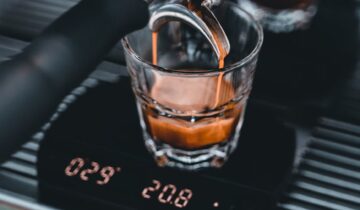
- Weighing your dose and yield: Use a scale with 0.1g accuracy. Dosing by volume or “eyeballing it” introduces massive inconsistencies that negate the stability your PID provides. Aim for a consistent dose in your basket every single time.
Inconsistent puck preparation: The weak link
Building on the fundamentals, puck preparation is the final hands-on step where things can go wrong. Stable water temperature from the PID will mercilessly exploit any flaw in your coffee puck. If your coffee grounds are clumpy or unevenly distributed, the water will carve channels through the path of least resistance, leading to a shot that is simultaneously sour and bitter. The PID has done its job, but your prep work has let it down.
To solve this, you need a repeatable puck prep routine. Start with a distribution tool, like a simple Weiss Distribution Technique (WDT) tool made from acupuncture needles, to break up clumps and evenly distribute the grounds. After distributing, ensure you tamp on a level surface with consistent, firm pressure. The goal isn’t to tamp as hard as possible, but to tamp level. A crooked tamp will lead to one side of the puck extracting faster than the other. Perfect temperature control is wasted if the water can’t flow evenly through the coffee.
Conclusion
Installing a PID on your Gaggia Classic is an excellent upgrade that offers a new level of control. However, it’s a tool, not a solution in itself. By avoiding common workflow mistakes, you can truly harness its power. Remember to account for the temperature offset and always preheat your machine and portafilter thoroughly. Respect the machine’s single boiler design by adopting a consistent brew-then-steam workflow. Most importantly, use the temperature stability provided by the PID as a solid foundation upon which to perfect your fundamentals: fresh beans, a proper grind, and meticulous puck preparation. The PID gives you consistency; it’s up to you to provide the quality ingredients and technique to match it.

 No products in the cart.