

Dialing in light roast espresso on a Gaggia Classic is a pursuit that challenges even experienced home baristas. These dense, delicately flavored beans demand a level of precision that the stock Gaggia wasn’t entirely designed for. Unlike their darker roasted counterparts, light roasts are less soluble, requiring more energy—in the form of stable heat and controlled pressure—to unlock their complex notes of fruit and florals. For the manual espresso user, this presents a rewarding puzzle. Mastering this process transforms the Gaggia Classic from a capable entry-level machine into a tool for nuanced, high-quality espresso extraction. This guide offers a technical, real-world approach to achieving that goal, focusing on process and technique over simple recipes.
Understanding the challenge with light roasts
Light roast coffees are significantly denser and less brittle than dark roasts. During the roasting process, they retain more of their cellular structure, making them harder to grind and less porous. This physical difference has direct implications for espresso extraction. Water struggles to penetrate the coffee bed evenly, increasing the risk of channeling, where water finds paths of least resistance and bypasses most of the coffee grounds. This results in an espresso shot that is simultaneously sour and bitter—a hallmark of under-extraction mixed with localized over-extraction.
The Gaggia Classic, in its factory configuration, presents two primary obstacles. First is its temperature instability. The small boiler and simple bimetallic thermostat create wide temperature swings, which can be detrimental to extracting the delicate compounds in light roasts. Second is its high brew pressure, often set at 12 bars or more. This intense pressure can easily fracture the delicate puck structure of a finely ground light roast, exacerbating the tendency for channeling and leading to astringent, unbalanced shots.
Grind quality and puck preparation
The foundation of any good extraction is a uniform, consistent grind. With light roasts, this is non-negotiable. A high-quality burr grinder capable of fine, unimodal adjustments is essential. Blade grinders or lower-end burr grinders produce an inconsistent particle size distribution, with too many large particles (boulders) and very fine particles (fines). This inconsistency makes channeling almost inevitable. When grinding light roasts, you will often need to go finer than you would for a medium or dark roast to increase the available surface area for extraction.
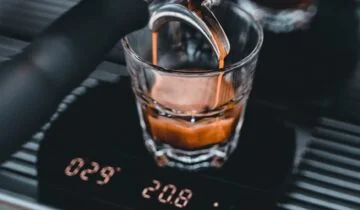
Puck preparation is equally critical. Start with a consistent dose, using a scale to measure your coffee to within 0.1 grams. After grinding, distribute the grounds evenly in the portafilter to break up clumps and eliminate voids. A simple tapping motion or a dedicated distribution tool can achieve this. Tamping should be firm, level, and consistent. The goal is not to tamp as hard as possible but to create a uniformly compacted puck that will encourage water to flow through it evenly, rather than finding or creating weak spots.
Mastering temperature stability
The Gaggia Classic’s single boiler and basic thermostat create a heating cycle with significant temperature fluctuations. For light roasts, which extract best at higher, stable temperatures (typically 94-96°C or 201-205°F), managing this cycle is paramount. The technique known as temperature surfing allows you to initiate the brew process at a more consistent and predictable point in the heating cycle.
A common method involves these steps:
- Turn on the machine and allow it to fully heat up for at least 20 minutes with the portafilter locked in.
- Purge a few ounces of water through the group head until the brew light turns off. This indicates the boiler is now heating.
- Wait for the brew light to turn back on, signaling the boiler has reached the top of its heating cycle.
- Start your shot at a specific, repeatable time after the light turns on. This time—often between 5 and 15 seconds—is your variable. Shorter waits result in higher brew temperatures. By keeping this interval consistent, you can achieve more stable shot-to-shot temperatures.
Logging your wait time and tasting the results will help you find the optimal point for your specific coffee.
Controlling pressure and pre-infusion
While the Gaggia Classic’s high stock pressure is a known challenge, it can be manually manipulated to improve light roast extractions. An abrupt, high-pressure start can shatter the coffee puck. A gentle pre-infusion, or pre-wetting of the grounds at low pressure, helps settle the coffee bed and allows it to swell, creating more resistance to the full pressure that follows. This significantly reduces the risk of channeling.
You can perform a simple manual pre-infusion by opening the steam valve slightly while engaging the brew switch for a few seconds. This diverts some of the water flow, lowering the initial pressure that hits the puck. An alternative is to open the brew switch for 2-4 seconds to wet the puck, then close it for a few seconds to let it bloom before re-engaging the pump for the full extraction. This technique requires practice but can yield a much more balanced and even extraction, transforming harsh shots into sweeter, more nuanced cups.
A practical dialing-in workflow
When dialing in a new light roast, a systematic approach is essential. Instead of changing multiple variables at once, adjust one at a time and taste the result. Below is a sample starting point and workflow.
| Parameter | Starting Point | Objective |
|---|---|---|
| Dose | 17g in a 17g precision basket | Keep this constant initially. |
| Yield | 34g (1:2 ratio) | Your primary variable for taste adjustment. |
| Time | 25-35 seconds | An outcome of grind size, not a target itself. |
| Temperature | Consistent surfing technique | Eliminate temperature as a variable. |
Start by pulling a shot with these parameters. If the shot tastes sour and thin (under-extracted), your first adjustment should be to grind finer. This will slow the shot down and increase extraction. If it tastes bitter or astringent (over-extracted), grind coarser. Only after you’ve found a balanced grind setting should you begin experimenting with yield. Pulling a longer shot (e.g., 1:2.5 ratio, or 42.5g out) can highlight acidity and delicate notes, while a shorter shot may increase body and sweetness. Keep detailed notes on each shot to track your progress.
Successfully extracting light roasts on a Gaggia Classic is a measure of a barista’s understanding of espresso fundamentals. It requires moving beyond factory settings and actively managing the variables of temperature and pressure. By focusing on a consistent grind, meticulous puck preparation, and manual control over the machine’s inherent quirks, you can produce espresso that is both technically sound and delicious. This process rewards precision and patience, turning a challenging task into a deeply satisfying aspect of the home espresso ritual. For those looking to refine their process, quality accessories and tools that support consistency are available from retailers like papelespresso.com.

 No products in the cart.