

The pursuit of exceptional espresso is a journey of precision. For the dedicated home barista, especially those using manual or prosumer machines, achieving shot-to-shot consistency is often the final frontier. While manual control offers unparalleled flexibility, it also introduces variability. Even minor, unintentional fluctuations in temperature, pressure, or flow can alter the delicate balance of acids, sugars, and oils that define a perfect extraction. This article explores how microcontroller-based automation can bring a new level of digital precision to the analog art of espresso, helping to minimize these variations and unlock a more repeatable workflow.
Understanding the variables in manual espresso
An espresso shot is the result of a complex interplay between several key variables. While the barista directly controls the dose, grind, and tamp, the machine governs the water delivery. In a manual or semi-automatic setup, the operator is responsible for managing the machine’s variables, which are the primary source of inconsistency.
- Brew temperature: The temperature of the water as it hits the coffee puck directly influences which compounds are extracted. Even a deviation of one or two degrees can shift the balance of a shot from bright and acidic to dull or bitter. In many machines, boiler temperature cycles and group head temperature fluctuations create a constantly moving target.
- Brew pressure: The force applied to the water dictates how it saturates the coffee puck and extracts soluble compounds. A traditional shot profile involves a stable 9-bar pressure, but manual lever machines create a declining profile. Inconsistencies in how pressure is applied, especially during pre-infusion and ramp-up, can lead to channeling and uneven extraction.
- Flow rate: Directly related to pressure, the flow rate is the volume of water moving through the puck over time. An uncontrolled flow rate can fracture the puck early on or fail to provide enough contact time for a full extraction. Managing flow is critical for achieving proper saturation and a balanced yield.
Attempting to control all these factors manually, shot after shot, is an immense challenge. A slight hesitation on a lever or a minor temperature swing in the boiler can produce a noticeably different result in the cup. This is where automation provides a powerful solution.
How microcontrollers bring digital precision to an analog process
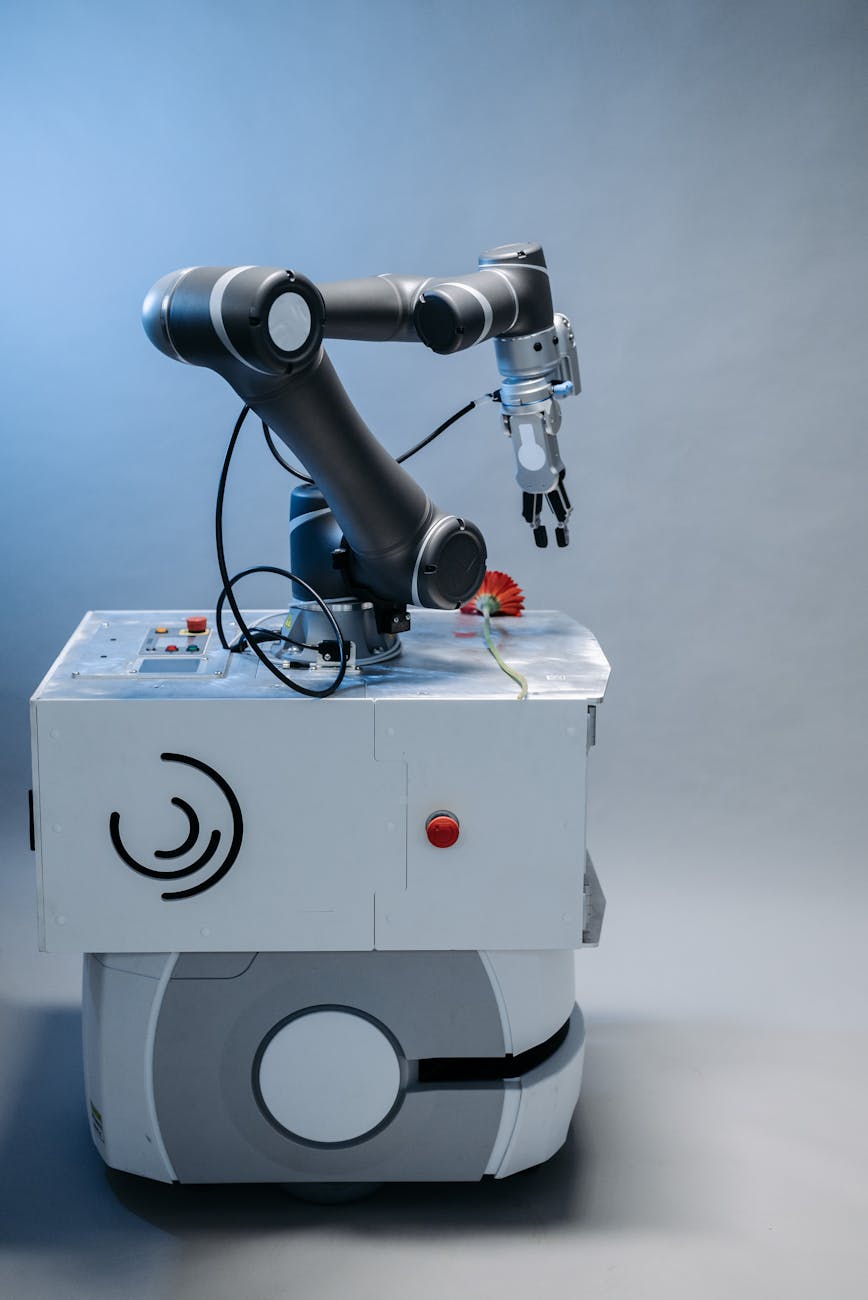
A microcontroller is a compact integrated circuit, essentially a tiny computer on a single chip, designed to govern a specific operation in an embedded system. In the context of an espresso machine, it acts as a brain, reading data from sensors and sending commands to mechanical components (actuators) to precisely control the brewing process.
The core components of such a system include:
- Sensors (Inputs): These devices measure the physical state of the machine in real time. Thermocouples or RTD probes monitor boiler and group head temperature, while pressure transducers measure hydraulic pressure in the system. Flow meters can be added to track the volume and speed of water delivery.
- Actuators (Outputs): Based on the microcontroller’s calculations, these components execute changes. A PID (Proportional-Integral-Derivative) algorithm can manage a solid-state relay to pulse the heating element with incredible precision. Solenoid valves can be opened or closed to direct water flow, and the speed of a pump can be modulated to control pressure and flow rate.
– Microcontroller: This processor reads the incoming data from the sensors, compares it to a desired setpoint or pre-programmed profile, and calculates the necessary adjustments.
By creating this feedback loop, a microcontroller can make thousands of calculations and adjustments per second, a task no human operator can replicate. It transforms the machine from a passive tool into an active, responsive system capable of executing a brew plan with digital accuracy.
Achieving thermal equilibrium with PID control
One of the most significant and accessible upgrades for reducing shot variation is automating temperature stability. Many traditional machines use a simple mechanical pressurestat or thermostat to control the heating element. This on/off system creates a wide temperature band, forcing the barista to perform a “cooling flush” or “temperature surfing” to try and catch the brew water at the right point in the heating cycle. This technique is inconsistent by nature.
A microcontroller running a PID algorithm offers a far more sophisticated solution. Instead of crudely turning the heater on or off, a PID controller constantly modulates the power sent to the heating element. It analyzes not just the current temperature, but also the history of past errors and the rate of current change. This allows it to learn the thermal properties of the system and intelligently apply power to hold the temperature steady, often within a fraction of a degree of the target. By eliminating temperature swings as a variable, the barista can be confident that every shot is starting from the same thermal baseline.
Moving beyond presets with automated profiling
While thermal stability is foundational, the most advanced application of microcontroller automation lies in controlling pressure and flow. This moves beyond simply holding a static variable and into the realm of dynamic profiling, allowing the barista to design and execute complex extraction strategies that are perfectly repeatable.
With a microcontroller managing the pump and valves, a user can program a multi-stage brew process. For example, a shot recipe could be designed as follows:
- Pre-infusion: Start with a 3 ml/second flow rate for 8 seconds to gently saturate the puck without fracturing it.
- Ramp-up: Smoothly increase pressure to 9 bars over 4 seconds.
- Full pressure: Hold a steady 9 bars until 20 grams of espresso have been yielded.
- Ramp-down: Gradually decrease pressure to 6 bars for the remainder of the shot to reduce the extraction of bitter compounds and prevent late-stage channeling.
Executing this profile manually would be impossible. With a microcontroller, it becomes a pre-set that can be initiated with the push of a button. This allows the barista to isolate the impact of other variables, like grind size, with scientific certainty. It turns the machine into a stable platform for experimentation, where changes in the cup can be confidently attributed to intentional adjustments rather than random machine behavior.
Conclusion
Integrating microcontroller automation into a manual espresso setup is not about diminishing the barista’s role, but rather enhancing it. By delegating the repetitive and physically impossible task of minute-to-minute variable management to a precise digital controller, the operator is freed to focus on the elements that matter most: the coffee, the grind, and the recipe. This technology stabilizes the machine, effectively removing it as a source of random variation. The result is a workflow where each shot is a true reflection of the barista’s intent, providing the consistency needed to systematically dial in a coffee and explore its full potential. For those looking to elevate their craft, precision tools that support this methodical approach are available at papelespresso.com.
 No products in the cart.