

The role of microcontrollers in modern home espresso
The world of high-end home espresso has traditionally been one of mechanical beauty and tactile feedback. From the satisfying pull of a manual lever to the robust simplicity of an E61 grouphead, the focus has been on the user’s direct physical control. However, a quiet revolution has been taking place inside the machine. The integration of microcontrollers, or MCUs, is fundamentally shifting the landscape of espresso preparation. These tiny, dedicated computers are not about replacing the barista’s skill. Instead, they provide a level of precision, repeatability, and insight that was once the exclusive domain of commercial labs, empowering the experienced home user to achieve a deeper understanding and control over their craft.
From guesswork to data: the sensor integration
At its core, a microcontroller is a small computer on a single integrated circuit. Its power lies in its ability to process inputs from various sensors and produce outputs to control other components. In the context of an espresso machine, the MCU acts as a central nervous system. It can receive real-time information from a network of sensors, including thermistors for temperature, pressure transducers for pump or grouphead pressure, and flow meters to measure water debit. This constant stream of data transforms the brewing process from one based on feel and observation to one informed by precise, objective measurements. The MCU interprets these inputs in milliseconds, providing the foundation for all subsequent control and feedback.
Precision temperature: the impact of PID controllers
One of the most significant early applications of microcontrollers in espresso machines was for thermal management. Older machines often rely on simple thermostats, which operate within a wide temperature range, causing significant swings that can compromise shot-to-shot consistency. A microcontroller running a PID (Proportional-Integral-Derivative) algorithm offers a far more elegant solution. The MCU constantly monitors the boiler temperature via a sensor. It then uses the PID algorithm to calculate the precise amount of power to send to the heating element, making tiny, frequent adjustments to keep the temperature exceptionally stable, often within a fraction of a degree. For the barista, this unlocks the ability to consistently extract nuanced flavors, particularly from lighter roasts that are highly sensitive to thermal variation.
Active control: pressure and flow profiling
Perhaps the most transformative impact of microcontrollers is the ability to execute dynamic pressure and flow profiles. While manual levers have always offered a form of pressure profiling, it relies heavily on the user’s physical technique and is difficult to repeat perfectly. Microcontrollers digitize this control. By managing a variable-speed pump or an electronic valve, an MCU can be programmed to follow a specific pressure or flow curve throughout the extraction. This allows a barista to design and save profiles, for example, a gentle, low-pressure pre-infusion to saturate the puck, followed by a controlled ramp to nine bars, and a gradual decline to reduce bitterness at the end of the shot. This level of granular control opens up new possibilities for manipulating body, acidity, and overall flavor balance.
Closing the loop: data logging and shot analysis
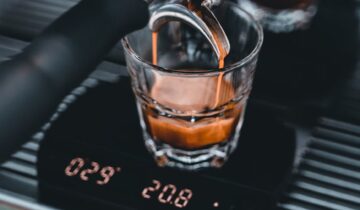
Beyond active control, microcontrollers enable a crucial feedback loop through data logging. What gets measured can be improved. By capturing the data from temperature, pressure, and flow sensors, the MCU can record a detailed log of the entire extraction process. This information can then be displayed on a screen or sent to an application for visualization. Seeing a graph of pressure versus time, overlaid with flow rate, allows a barista to move beyond subjective taste evaluation. It provides objective, actionable insight into exactly what happened during the shot. This data helps diagnose issues like channeling and allows for an iterative and informed approach to refining grind size, puck preparation, and brew ratios for a specific coffee.
In conclusion, the integration of microcontrollers into home espresso equipment represents a significant leap forward. It is not a move toward automation that removes the user, but rather a development that deeply empowers them. By providing precise thermal stability through PID control, enabling repeatable pressure and flow profiling, and offering detailed data for analysis, these small processors augment the barista’s skill set. They replace intuition with information and approximation with precision. For the dedicated home enthusiast, this shift allows for a more deliberate and analytical approach to their craft, fostering a greater understanding of the extraction process. Exploring the tools that incorporate this technology, such as those available from papelespresso.com, can be a valuable step for any barista seeking ultimate control.
 No products in the cart.