

Why your Olympia Cremina group head is overheating and how to fix it
The Olympia Cremina is a masterpiece of Swiss engineering, a manual lever espresso machine revered for its build quality and the exceptional shots it can produce. However, many new owners, and even some seasoned users, encounter a frustrating problem: a group head that gets too hot. This leads to a cascade of issues, primarily resulting in bitter, burnt-tasting espresso that fails to capture the nuance of your coffee beans. An overheated group head is one of the most common hurdles to overcome with a Cremina. This article will demystify why this happens, explaining the thermal principles of the machine and providing you with a clear, actionable toolkit to manage temperature, control your extractions, and finally pull consistently delicious shots.
Understanding the Cremina’s thermal design
To solve the overheating problem, you first need to understand why it happens. The Olympia Cremina is a direct-lever, dipper-style machine. This means the group head is bolted directly onto the boiler. Unlike more complex machines that use a thermosyphon or E61 group to circulate water and maintain a stable temperature, the Cremina relies on a simpler, more direct method: conduction.
Heat from the boiler constantly travels into the solid brass of the group head. This is intentional. The group head must be hot enough to maintain the water temperature during the few seconds of extraction. If it were cold, it would zap the heat from the brew water, resulting in a sour, under-extracted shot. The issue arises not from a design flaw, but from the machine’s intended use pattern. The continuous heat transfer means that if the machine is left on for too long, the group head’s temperature will keep rising, far surpassing the ideal brewing range of approximately 90-96°C (194-205°F).
The main cause: Machine idle time
The single biggest reason a Cremina group head overheats is that it has been left on for too long. This machine is not designed to be switched on in the morning and left running until lunchtime. It is a “walk-up” machine, intended for short, focused sessions.
A typical heat-up cycle for a Cremina is remarkably fast. From a cold start, it usually only takes 10 to 15 minutes for the boiler to reach pressure and the group head to reach a stable, brew-ready temperature. During this time, the machine finds its thermal equilibrium. If you leave it on for 30 minutes, 45 minutes, or an hour, that equilibrium is lost. The group head becomes a heat sink, continuing to absorb thermal energy from the boiler until it is scorching hot to the touch and far too hot for brewing coffee.
Recognizing this is the first step to mastering your machine. You must adjust your workflow to match the Cremina’s design, rather than treating it like a semi-automatic machine that can idle for hours.
Practical techniques for temperature management
Once you understand that time is the enemy of thermal stability, you can implement several effective techniques to control your group head temperature. These methods range from simple workflow adjustments to more hands-on cooling tactics.
- Adjust your workflow: The simplest solution is the best. Turn your Cremina on about 15 minutes before you want to make coffee. Pull your shot or series of shots, and then turn the machine off. This prevents the group head from ever reaching an overheated state.
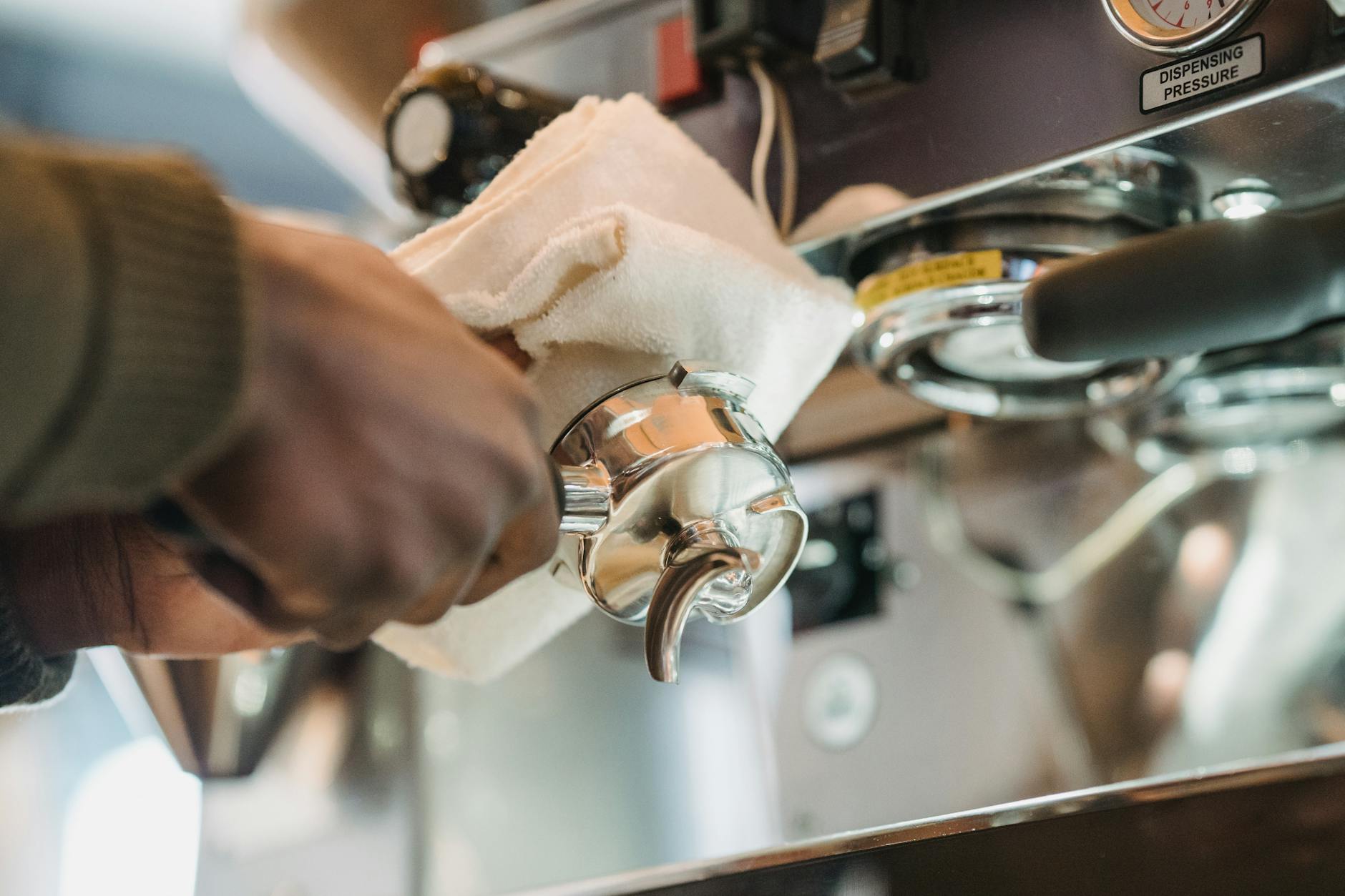
- Use a cold, wet towel: If your group head is already too hot, or if you’re pulling multiple shots and notice the temperature creeping up, a damp towel is your best friend. Wring out a cloth in cold water and wrap it around the bell of the group head for 30-60 seconds. You will hear it sizzle as it quickly draws heat away. This is a very effective and fast way to lower the temperature.
- Portafilter cooling sinks: Another excellent technique is to use the portafilter itself as a heat sink. Lock a cool portafilter into the hot group head. The mass of the cold brass will absorb a significant amount of heat. For even faster cooling, you can run the portafilter under a cold tap before locking it in. Repeat as necessary until the desired temperature is reached.
- Invest in a temperature strip: To take the guesswork out of temperature management, apply a simple stick-on thermometer strip to the side of your group head. These strips change color to indicate the temperature, giving you a clear visual cue when the group is too hot, too cold, or just right for brewing.
Advanced tuning and maintenance
While workflow is the primary factor, a couple of maintenance and tuning aspects can influence your machine’s heating characteristics. If you’ve mastered the basic techniques and still face challenges, it may be time to look a little deeper.
First, consider your boiler pressure. The temperature of the water in your boiler is directly related to its pressure, which is regulated by a component called the pressurestat (PSTAT). If your PSTAT is set too high (e.g., above 1.2 bar), the boiler will run hotter, accelerating how quickly the group head overheats. Most users find a setting between 0.8 and 1.1 bar provides a great balance of steam power and thermal stability. Adjusting the PSTAT is a task for advanced users and should only be done when the machine is unplugged and has cooled down.
Second, inspect your piston seals. While worn seals won’t directly cause overheating, they can make your brewing experience inconsistent and frustrating. If your lever feels “spongy,” doesn’t engage smoothly, or if you see water leaking from the top of the piston during a shot, it’s time to replace them. Fresh, properly lubricated seals are essential for the machine to operate as designed and for you to have full control over your extraction.
Troubleshooting summary
| Symptom | Probable Cause | Solution |
|---|---|---|
| Espresso tastes bitter and burnt | Group head is too hot | Cool the group with a wet towel or cold portafilter; shorten machine on-time. |
| Machine gets too hot very quickly | Boiler pressure (PSTAT) is set too high | (Advanced) Lower the PSTAT setting to 0.8-1.1 bar. |
| Inconsistent shots and leaky lever | Worn piston seals | Replace and lubricate the piston seals. |
| Unsure of group temperature | Guessing brew temperature | Apply a temperature strip to the group head for a visual reading. |
Conclusion
An overheating group head on an Olympia Cremina is not a sign of a faulty machine but rather a characteristic to be managed. Its direct-lever design, where the group is bolted to the boiler, means that prolonged idle time will inevitably lead to excessively high temperatures. By understanding this core principle, you can regain control. The solution lies in adjusting your workflow: turn the machine on only when you need it and turn it off afterward. For moments when it does get too hot, simple but powerful techniques like using a cold, damp cloth or a cool portafilter can quickly bring the temperature back into the ideal range. Mastering your Cremina is a journey of mastering its heat. Embrace these practices, and you will transform your espresso from a game of chance into a consistent and rewarding daily ritual.


 No products in the cart.