

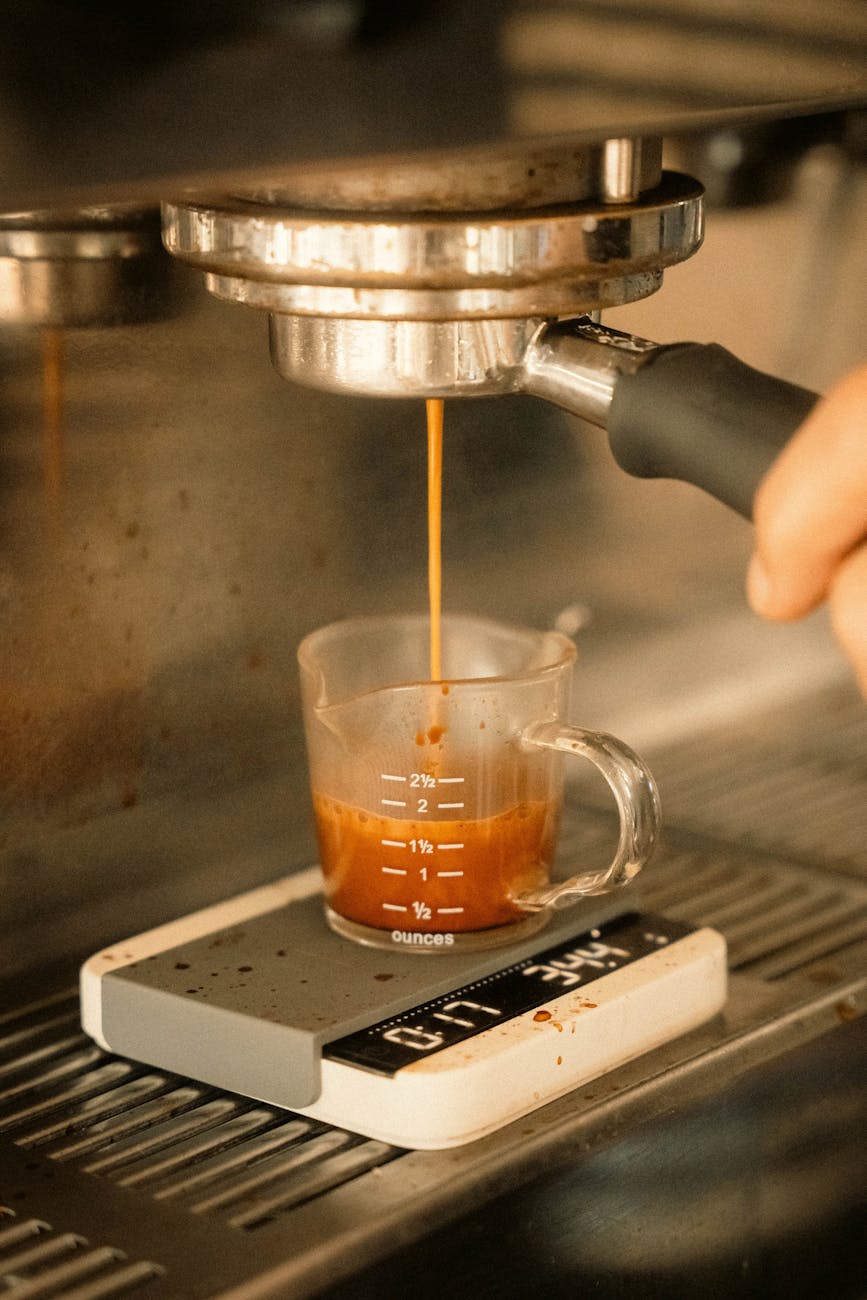
The impact of drip tray height on your espresso measuring accuracy
In the meticulous craft of brewing espresso, we obsess over variables. We fine-tune our grind size to perfection, weigh our coffee dose to a tenth of a gram, and monitor brew temperatures with unwavering focus. Yet, a surprisingly influential factor often goes unnoticed: the physical distance between the portafilter spouts and the coffee scale. This gap, dictated by the height of your espresso machine’s drip tray, might seem insignificant. However, this vertical space can introduce surprising inaccuracies into your measurements. This article will delve into the physics behind the falling espresso stream and explore how the height of your drip tray can directly impact the precision of your final yield, ultimately affecting the taste in your cup.
The physics of a falling espresso stream
When espresso begins to flow from the portafilter, it’s not just gently trickling into your cup. It’s a liquid stream subject to the laws of physics, primarily gravity. As the espresso falls, it accelerates, gaining velocity and kinetic energy. The greater the distance it has to fall—in other words, the taller the space above your drip tray—the faster it will be moving when it hits the surface of the liquid in your cup.
This increased velocity has a direct consequence: impact force. A stream of espresso hitting your cup from a greater height doesn’t just add weight; it adds force. Highly sensitive coffee scales, designed to register tiny increments in mass, can misinterpret this impact force as additional weight. This creates a volatile and fluctuating reading on the scale’s display, a phenomenon often referred to as “splatter” or measurement noise. Instead of a smooth, steady climb in grams, you see a jumpy, erratic reading, making it incredibly difficult to know the true weight of the liquid in the cup at any given moment.
How scale sensitivity and response time play a role
The problem of impact force is compounded by the very nature of our brewing tools. Modern coffee scales are marvels of sensitivity, often measuring in increments of 0.1 grams. This precision is fantastic for dosing but can become a liability when subjected to the forceful impacts described above. The scale’s load cell is designed to measure static weight, but the constant, high-energy impact from a tall drop creates a dynamic force that confuses it.
This leads to two primary issues:
- Overshooting: The scale might momentarily display a weight that is higher than the actual liquid yield. For example, the force of the stream could make the scale jump to your target of 36 grams when there are only 34 or 35 grams of liquid in the cup. If you stop the shot based on this false peak, you will have an under-extracted, less balanced shot.
- Measurement lag: A scale needs a fraction of a second to stabilize and provide a true reading. The constant bombardment from a high-velocity stream prevents the scale from ever truly stabilizing during the brew. This forces you to guess when to stop, introducing inconsistency from one shot to the next. The final weight you see after the shot is finished and the scale settles is often different from the target you were aiming for mid-shot.
The practical effects on your espresso recipe
This lack of precision isn’t just an academic problem; it directly sabotages your ability to follow a recipe and achieve repeatable results. The foundation of modern espresso is the brew ratio—the relationship between the dry coffee dose and the final liquid yield. A small deviation of just one or two grams in yield can dramatically alter the taste and texture of your espresso.
Consider a standard 1:2 ratio using 18 grams of coffee grounds, targeting a 36-gram yield. If measurement errors caused by a high drip tray lead you to consistently produce shots that are 34 grams, your coffee will be stronger, more concentrated, and potentially sour or under-extracted. Conversely, if you consistently overshoot and end up with 38-gram shots, your espresso will be weaker, more watery, and likely bitter or over-extracted. Without accurate measurement, you are chasing a moving target, and diagnosing issues with your grind or puck prep becomes nearly impossible because you can’t trust your most important output metric: yield.
| Drip tray height | Observed scale fluctuation | Potential yield error | Impact on taste consistency |
|---|---|---|---|
| Low (e.g., < 3 inches) | Minimal, stable reading | +/- 0.5 grams | High. Easy to replicate shots and diagnose other variables. |
| High (e.g., > 5 inches) | Erratic, jumpy reading | +/- 2.0 grams or more | Low. Shots are inconsistent, making it hard to dial in flavor. |
Solutions for accurate espresso measurement
Fortunately, overcoming this challenge is straightforward once you’ve identified it. The goal is simple: reduce the distance the espresso has to fall. By minimizing this gap, you reduce the stream’s velocity and impact force, allowing your scale to provide a much more stable and accurate reading.
Here are some effective best practices:
- Raise your scale: The easiest solution is to place a stable, heat-proof object on top of your drip tray to act as a riser for your scale. An upside-down ceramic ramekin, a small block of wood, or a purpose-made scale stand all work perfectly. This brings the cup directly under the portafilter.
- Use a low-profile scale: Many coffee accessory brands offer “slim” or “low-profile” scales designed specifically to fit in the tight space of home espresso machines. Investing in one can solve the problem permanently.
- Learn your scale’s latency: Even with a perfect setup, every scale has a slight delay. Practice pulling shots and notice how much liquid is added between the moment you cut the machine off and the moment the flow stops completely. Often, you’ll need to stop the shot 0.5 to 1.5 grams before your target weight to account for these last few drops.
By implementing these simple adjustments, you can eliminate a significant source of measurement error and regain control over your espresso yield, paving the way for more consistent and delicious coffee.
Conclusion
In conclusion, the height of your drip tray is far more than an aesthetic design choice; it is a critical variable that directly influences your ability to measure espresso yield accurately. We’ve seen how a greater falling distance increases the espresso stream’s velocity, creating an impact force that confuses sensitive coffee scales. This leads to erratic readings, making it difficult to stop a shot at a precise target weight. The resulting inconsistencies in your brew ratio can sabotage your recipe, leading to unpredictable flavors and frustrating dialing-in sessions. By taking simple, practical steps—such as raising your scale or using a low-profile model—you can mitigate this issue entirely. Paying attention to this small detail elevates your precision, ensuring your meticulously prepared dose and grind are not wasted by an avoidable measurement error.

 No products in the cart.