

Sand brewing vs. stovetop: The ultimate guide to heat control for home coffee
The quest for the perfect cup of coffee at home often leads us down a rabbit hole of grinders, beans, and water quality. Yet, one of the most critical and frequently overlooked variables is the heat source itself. How you apply heat to your brewer dramatically impacts extraction, flavor, and consistency. For most home baristas, the journey begins and ends with a stovetop, a direct and sometimes unruly source of energy. But there is another method, rooted in tradition and revered for its gentle precision: sand brewing. This article delves into the nuances of sand brewing versus traditional stovetop methods, exploring how controlling your heat source is the key to unlocking better, more consistent results right in your own kitchen.
The foundation of extraction: Why heat control matters
Before comparing methods, it’s crucial to understand why heat is so fundamental to coffee brewing. Water acts as a solvent, and heat is the catalyst that accelerates its ability to dissolve the soluble compounds within coffee grounds—the very things that give coffee its flavor, aroma, and body. However, this process is incredibly delicate. Too little heat, and you get under-extraction, resulting in a cup that is sour, weak, and grassy. Too much heat, or heat applied unevenly, leads to over-extraction, creating a bitter, harsh, and often burnt taste.
The ultimate goal is not just to reach a target temperature, but to maintain a stable and evenly distributed heat throughout the brewing cycle. This is where the difference between heat sources becomes most apparent. An unstable heat source can cause the water temperature to fluctuate, extracting different compounds at different rates and creating an unbalanced final product. Even heat distribution prevents “hot spots” on the bottom of your brewer, which can scorch the grounds they touch, releasing unpleasant flavors into an otherwise perfect brew.
The classic approach: Taming the stovetop flame
The stovetop, whether gas or electric, is the most common heat source for home brewing methods like the Moka pot, a stovetop percolator, or simply heating water in a kettle for a pour-over. It’s accessible and familiar, but it comes with significant challenges related to heat management.
The primary issue with a stovetop is its direct and often intense heat. A gas flame or an electric coil concentrates energy on a small area at the bottom of the brewer. This can lead to several problems:
- Uneven Heating: The water at the bottom of the pot gets hot much faster than the water at the top, making uniform extraction difficult.
- Hot Spots: The direct contact point can become excessively hot, scorching the coffee grounds in a Moka pot or causing water in a kettle to boil violently and unpredictably.
- Lack of Stability: It’s difficult to maintain a precise temperature. Even on a low setting, the heat can cycle on and off, causing fluctuations that disrupt the delicate extraction process.
–
To mitigate these issues, seasoned stovetop users often employ a few tricks. Using a heat diffuser—a flat metal plate placed between the flame and the pot—can help distribute the heat more evenly. Starting on a very low flame and being patient is another key strategy. For methods like the Moka pot, many experts recommend removing it from the heat just before it finishes sputtering to let residual heat complete the brew without boiling and burning the coffee.
The art of immersion: How sand brewing delivers superior control
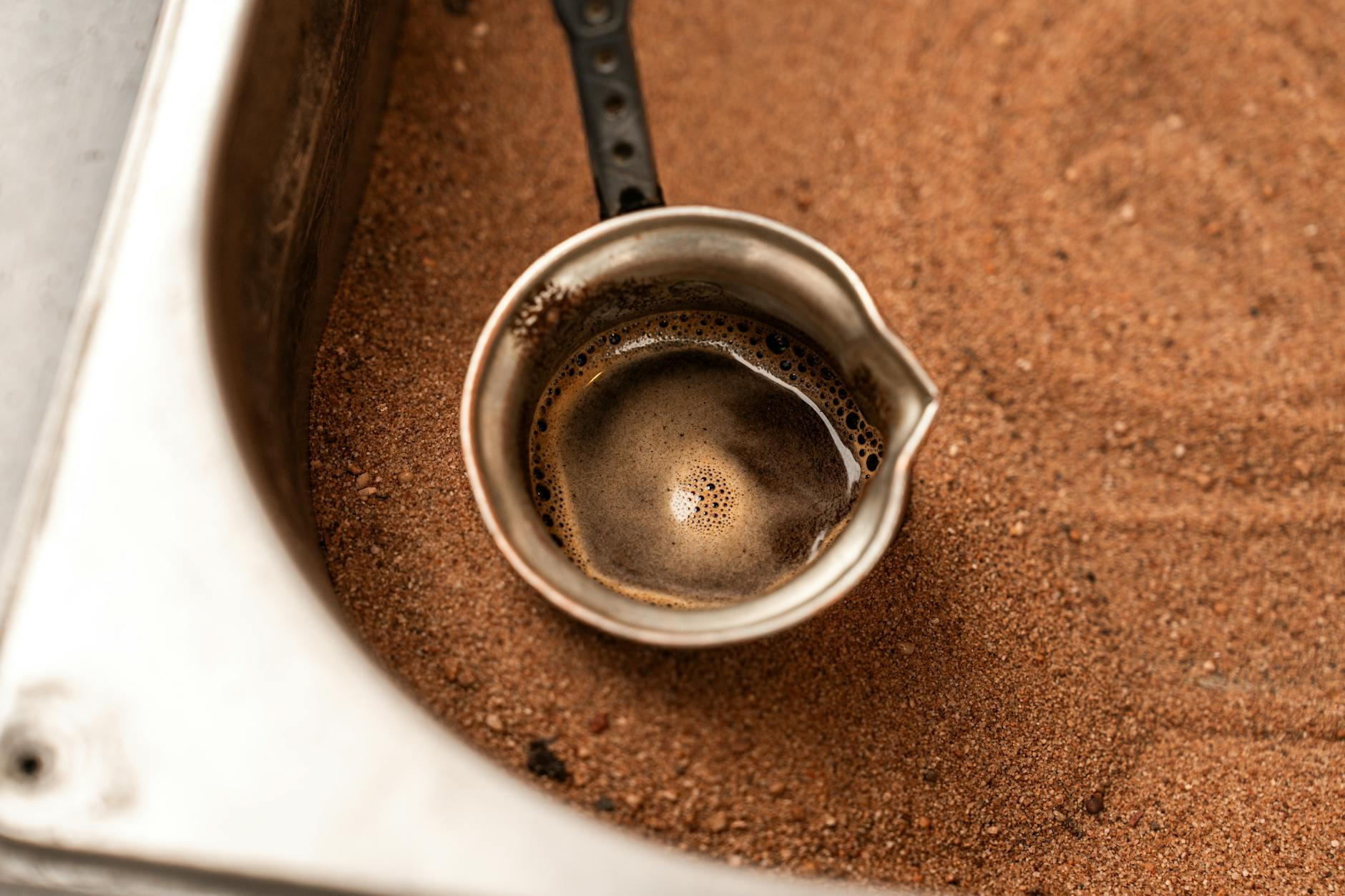
Sand brewing, known traditionally for making Turkish coffee, offers a completely different philosophy of heat application. Instead of direct contact, it uses a bed of hot sand as a thermal medium. A special machine or a deep, fire-safe pan is filled with sand, which is then heated from below. The coffee pot, typically a brass or copper cezve (or ibrik), is then nestled into the hot sand.
This method provides a level of control that is nearly impossible to achieve on a standard stovetop. The magic lies in three key principles:
- Indirect and Diffused Heat: The sand acts as a perfect buffer. It absorbs the intense energy from the heating element and radiates it gently and uniformly. There is no direct flame or coil touching the pot.
- 360-Degree Heating: Because the cezve is partially buried, it is heated from the bottom and the sides simultaneously. This envelops the coffee in a consistent thermal blanket, eliminating hot spots and promoting an incredibly even extraction.
- Precision and Finesse: The brewer has dynamic control over the heat. By moving the cezve around in the sand—pushing it deeper for more heat or pulling it toward the cooler edges—they can precisely manage the brewing temperature and control the signature foam formation of Turkish coffee without it boiling over.
The sand’s thermal inertia also means it holds a stable temperature, preventing the wild fluctuations common with direct stovetop heating. This results in a uniquely smooth, rich, and balanced extraction.
A head-to-head comparison for the home brewer
Choosing between stovetop and sand brewing depends on your goals, budget, and the type of coffee you wish to make. While the stovetop is a versatile workhorse, sand brewing is a specialist’s tool that offers unparalleled mastery over the brewing process. Let’s break down the key differences.
| Feature | Stovetop Brewing | Sand Brewing |
|---|---|---|
| Heat Control & Precision | Lower. Requires constant monitoring and adjustments to avoid boiling or temperature spikes. | Superior. Allows for micro-adjustments by moving the pot within the sand for precise temperature management. |
| Evenness of Extraction | Prone to unevenness and hot spots due to direct, bottom-up heating. | Excellent. Sand provides gentle, 360-degree heat for a highly uniform extraction. |
| Ease of Use / Learning Curve | Easy to start, but difficult to master for high-quality results. | Requires specialized equipment and practice to learn the technique, but offers more consistent results once mastered. |
| Versatility | Highly versatile. Used for Moka pots, percolators, kettles for pour-over, French press, etc. | Specialized. Primarily designed for Turkish coffee (using a cezve/ibrik) but the principle can be adapted. |
| Cost & Accessibility | Very accessible. Most kitchens already have a stovetop. Brewers are widely available and affordable. | Requires investment in a sand brewer or a DIY setup. Cezves are also necessary. Less common for home use. |
As the table shows, the stovetop wins on convenience and versatility. It’s the practical choice for most daily brewing needs. However, when the goal is absolute control and the highest quality extraction, especially for delicate methods like Turkish coffee, sand brewing is in a class of its own. The gentle, immersive heat protects the coffee from scorching and coaxes out complex flavors that direct heat can often destroy.
Conclusion: Choosing the right heat for your brew
Ultimately, understanding how heat works is more important than the source itself. While the common stovetop is a powerful tool, it is also a blunt instrument that requires skill and attention to yield great coffee. By using techniques like low flames and heat diffusers, you can tame its aggressive nature and significantly improve your results. In contrast, sand brewing represents the pinnacle of thermal control. It trades the convenience of the stovetop for a method that is gentle, precise, and incredibly consistent, allowing the brewer to achieve a truly uniform extraction. For the everyday coffee drinker, mastering the stovetop is a worthy goal. For the enthusiast dedicated to perfecting the art of Turkish coffee or exploring the outer limits of extraction science, investing in a sand brewer is a journey worth taking.


 No products in the cart.