

For the dedicated home barista, the espresso workflow is a cherished ritual. It’s a dance of precision involving grind size, dose, tamping pressure, and extraction time, all in pursuit of that perfect, syrupy shot crowned with a rich crema. But what happens when this quest for coffee perfection leads you down an older, more ancient path? Transitioning from the high-tech, high-pressure world of espresso to the slow, deliberate art of Turkish coffee can feel like learning a new language. This article is your guide to that transition. We will explore how to adapt your skills and mindset, from rethinking your equipment and grind to mastering a new brewing ritual and appreciating a completely different sensory experience. It’s time to trade the portafilter for a cezve and discover the rich heritage in every cup.
Rethinking your gear: From portafilter to cezve
The first and most obvious shift from an espresso workflow involves your equipment. While an espresso setup is a marvel of modern engineering designed for control and consistency, Turkish coffee gear is rooted in elegant simplicity and tradition. Your multi-thousand-dollar machine will take a back seat to a few key, yet humble, tools.
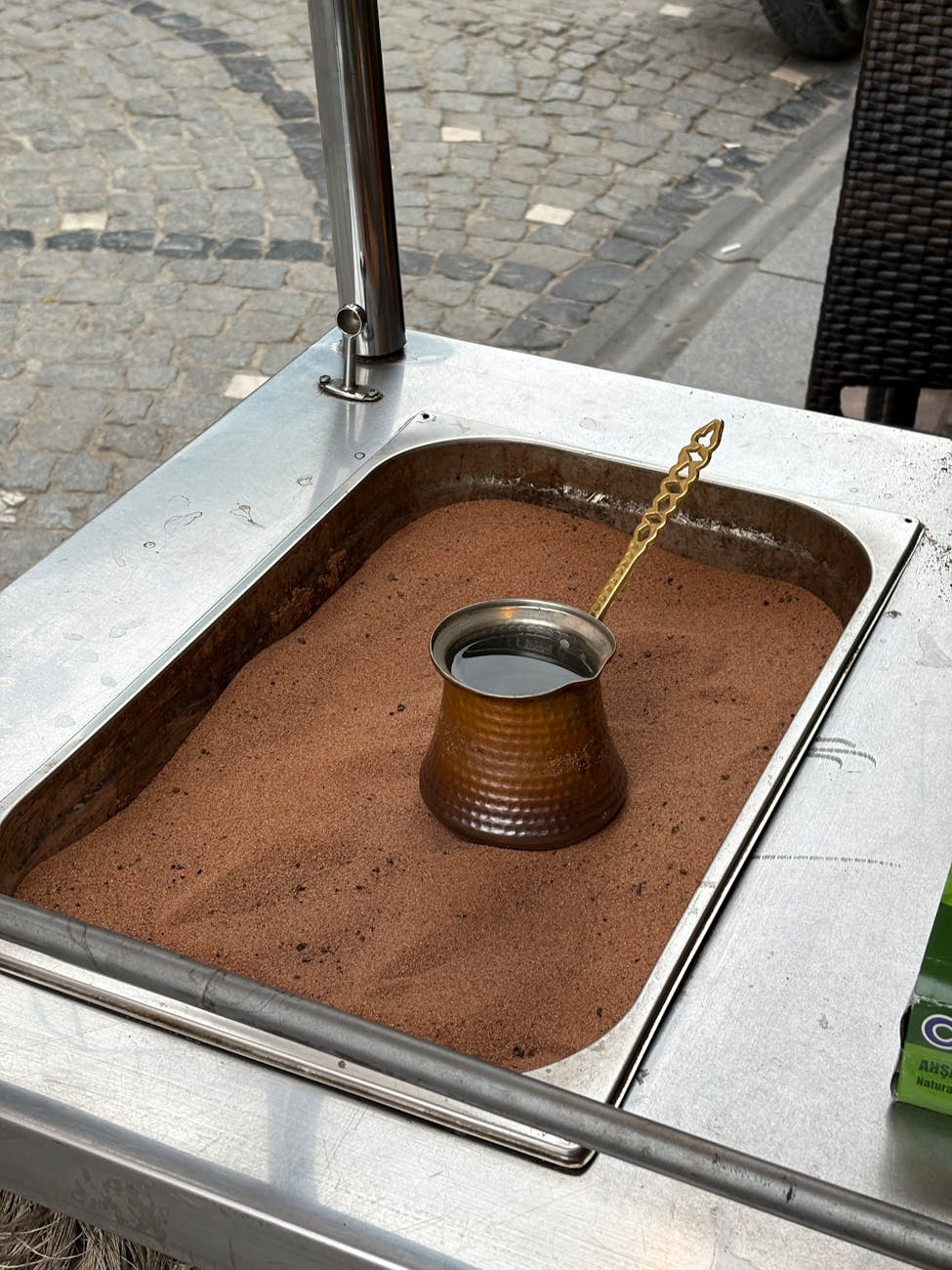
The centerpiece of this new setup is the cezve (also known as an ibrik). This small, long-handled pot is specifically designed with a wide base for even heating and a narrow neck to help build the essential foam. They are most traditionally made of copper, prized for its excellent heat conductivity, which gives you greater control over the brewing process. However, stainless steel and brass are also common, offering durability and ease of maintenance. For an espresso lover used to obsessing over temperature stability, understanding how a cezve’s material interacts with your heat source becomes your new focus.
Perhaps the most critical piece of equipment you’ll need to re-evaluate is your grinder. An espresso grind, as fine as it seems, is far too coarse for true Turkish coffee. You need to achieve a grind consistency that is as fine as powder or flour—so fine that it feels like dust between your fingers. While some high-end espresso grinders can approach this fineness at their tightest setting, many cannot. You may need to invest in a dedicated Turkish coffee grinder, either a traditional manual brass mill or a specialized electric one. This powdery grind is non-negotiable, as it is essential for creating the rich body and foam the brew is known for.
The art of the grind and dose
Having secured the right gear, your next adjustment lies in the fundamental building blocks of your brew: the coffee and water. In the world of espresso, you live by the scale. Dosing 18.0 grams for a 36-gram yield is second nature. Turkish coffee preparation, however, is traditionally less about precise grams and more about ratios and volume. The common starting point is one heaping teaspoon of coffee for every demitasse-sized cup of water you intend to serve. You measure the cold water using the very cup you will drink from, ensuring a perfect portion every time.
This is also where a major workflow diversion occurs. With espresso, any additions like sugar or milk happen after the shot is pulled. In Turkish coffee, sugar and even spices like cardamom are added directly into the cezve with the ground coffee and cold water before brewing begins. The amount of sugar is often determined by tradition, with common requests being sade (no sugar), az şekerli (a little sugar), orta (medium sugar), or çok şekerli (very sweet). This practice of brewing everything together from the start fundamentally changes the flavor profile, infusing the sweetness and spice notes throughout the body of the coffee itself.
Mastering the brew: A slow and deliberate ritual
This chapter marks the most significant departure from the espresso process. You must trade the 25-second, high-pressure extraction for a patient, 2-to-3-minute, low-heat infusion. The goal is no longer to force water through a compacted puck but to gently coax flavor from coffee suspended in water. The process is a ritual that demands your full attention.
Here’s the typical workflow:
- Add your measured cold water, ultra-fine coffee grounds, and any sugar to the cezve.
- Stir the mixture gently just until the grounds are saturated. Do not over-mix.
- Place the cezve on a low to medium heat source. This is not a race; slow heating is key to developing the foam.
- Watch closely. As the coffee heats, a dark ring of foam will begin to form and rise. This foam, or kaymak, is the Turkish coffee equivalent of crema and is highly prized.
- Just as the foam rises to the brim of the cezve, remove it from the heat. Crucially, you must not let it come to a rolling boil, as this will destroy the foam and create a bitter taste.
- You can gently spoon some of this initial foam into each serving cup. Some brewers will return the cezve to the heat a second or even a third time, repeating the rise of the foam to build a thicker layer.
- After the final rise, pour the coffee slowly and steadily into your demitasse cups to preserve the foam on top.
This process requires a new kind of patience, one that exchanges the mechanical precision of espresso for a more intuitive, sensory-driven technique.
A new sensory experience: From crema to sediment
Finally, your palate must adapt. An espresso shot is often a quest for bright acidity, complex origin notes, and a syrupy but clean finish. Turkish coffee offers a completely different, yet equally complex, sensory profile. Because the coffee is unfiltered, the body is much heavier, thicker, and more viscous. The ultra-fine grounds remain suspended in the liquid, contributing to a unique, rich texture.
The flavor is typically intense and robust, with lower perceived acidity than a typical espresso. The kaymak is less airy than crema, presenting as a dense, flavorful cap on the coffee. The most significant adjustment is learning to sip the coffee slowly, allowing the grounds to settle at the bottom of the cup. The final sip is avoided, leaving the thick sediment, or “mud,” behind. For an espresso drinker accustomed to a clean cup, this is a new discipline. The following table highlights the key differences in your workflow and final product.
| Feature | Espresso Workflow | Turkish Coffee Workflow |
|---|---|---|
| Grind Size | Fine, like table salt | Powder, like flour |
| Equipment | Espresso machine, portafilter, tamper | Cezve (Ibrik), spoon, heat source |
| Brew Time | 25-30 seconds | 2-3 minutes |
| Pressure | High (approx. 9 bars) | Low (atmospheric) |
| Filtration | Metal filter basket | None (grounds settle) |
| Key Indicator | Rich, stable crema | Thick, persistent foam (kaymak) |
| Additives | Added after brewing | Sugar/spices added before brewing |
Transitioning from espresso to Turkish coffee is more than a change in technique; it’s a shift in philosophy. It requires you to release your grip on precise metrics and embrace a more patient, observant, and ritualistic form of brewing. You move from a process defined by high-pressure speed to one of slow, deliberate infusion. The journey rewards you not just with a uniquely rich and flavorful cup, but with a connection to one of the world’s oldest coffee traditions. By adapting your knowledge of gear, grind, and process, you aren’t replacing your love for espresso. Instead, you are broadening your understanding of what coffee can be, appreciating the beauty in both the modern pursuit of perfection and the timeless art of a simple, shared brew.


 No products in the cart.