

How to identify when your espresso grinder is the weak link
You’ve invested in a gleaming espresso machine, sourced freshly roasted specialty beans, and perfected your tamping technique. Yet, your shots are inconsistent, tasting either sour or bitter, and never quite hitting that sweet spot you enjoy at your favorite cafe. While many factors contribute to a great espresso, one component is frequently overlooked yet critically important: the grinder. It’s often the unsung hero of a coffee setup, but it can just as easily be the villain. If you’re struggling to pull consistently delicious shots, the problem might not be your machine or your technique. This article will guide you through the tell-tale signs that your espresso grinder is the weak link in your chain, holding you back from coffee perfection.
The struggle with consistency and dialing in
The first and most obvious sign of a struggling grinder reveals itself during the “dialing in” process. This is the daily ritual of adjusting your grind size to achieve the perfect extraction, typically aiming for a 1:2 ratio (e.g., 18 grams of coffee in, 36 grams of liquid out) in about 25-30 seconds. If this process feels more like a game of chance than a science, your grinder is likely the culprit.
One major symptom is wild inconsistency. You pull a shot that chokes the machine, running for over 40 seconds. You don’t change the setting, prepare the next puck exactly the same, and it gushes out in 15 seconds. This frustrating experience points directly to an inconsistent grind. A poor-quality grinder produces a wide range of particle sizes, from fine dust to large boulders. The random distribution of these particles in your portafilter from one shot to the next creates unpredictable resistance for the water, leading to erratic shot times.
Another common issue is having large, clunky steps between grind settings. You find that one setting is too coarse, producing a fast, sour shot. You click it one step finer, and suddenly the grind is too fine, choking the machine and creating a bitter, over-extracted mess. There is no “in-between” setting that allows you to hit the sweet spot. This is a common limitation of many entry-level grinders not specifically designed for espresso, forcing you to compromise rather than truly dial in your coffee.
Analyzing the puck and the portafilter
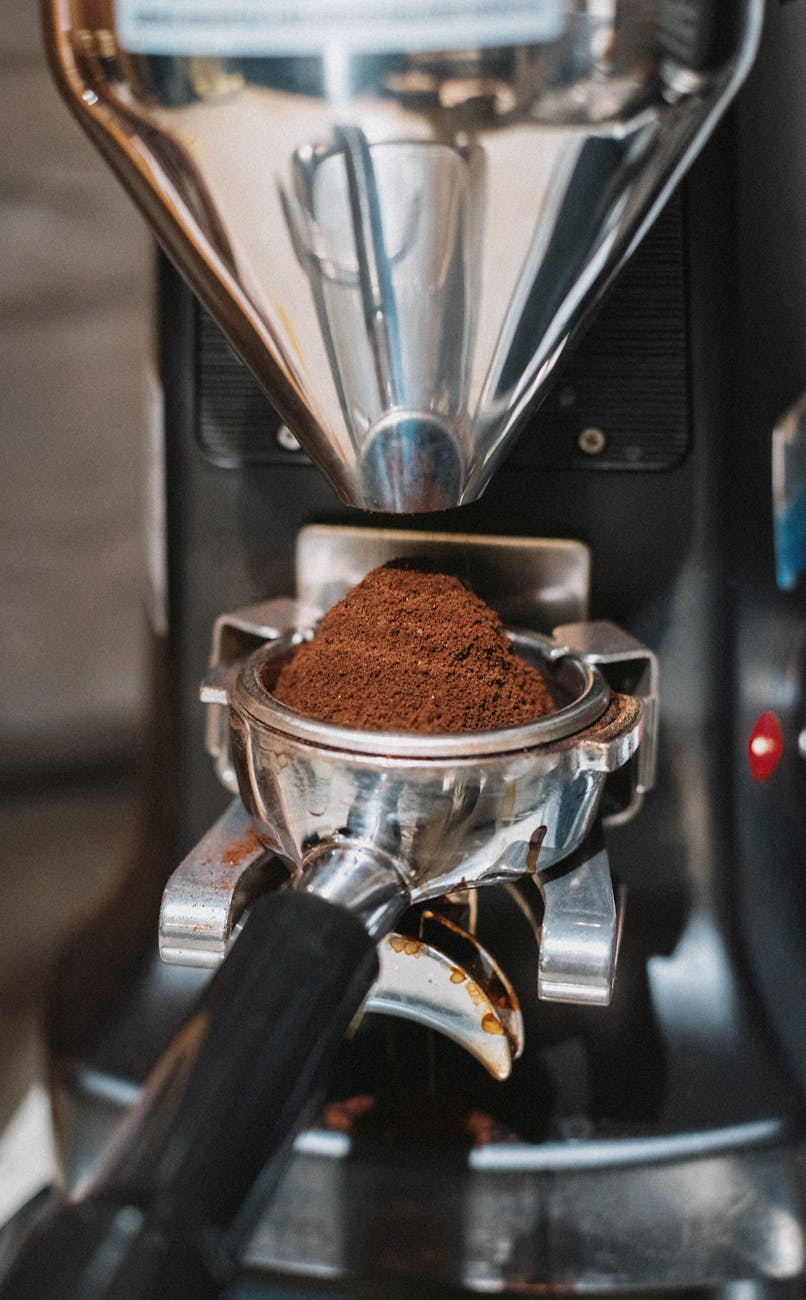
Before you even taste the coffee, the grounds themselves can offer crucial clues. A capable grinder produces a fluffy, uniform, and relatively clump-free mound of coffee. A grinder that’s not up to the task will show its flaws right in the portafilter basket.
The most significant visual indicator is channeling. After you pull a shot, inspect the spent coffee puck. Do you see tiny holes or cracks, or does it look soupy and disturbed? These are signs of channeling, where water finds a path of least resistance and blasts through one part of the puck while neglecting others. This is a direct result of an uneven grind. The mixture of large and small particles creates areas of low density, inviting the pressurized water to rush through, leading to a shot that is simultaneously under-extracted (from the neglected parts) and over-extracted (from the channels).
Excessive clumping is another red flag. While some grinders produce minor clumps that break apart easily, a weak grinder may produce dense, stubborn clumps due to static or poor burr geometry. These clumps are pockets of dry coffee that resist even water distribution, making an even extraction nearly impossible without meticulous puck preparation tools like a Weiss Distribution Technique (WDT) tool. If you find that WDT isn’t just improving your shots but is absolutely essential to avoid a disaster, your grinder is creating the problem rather than just having a minor quirk.
Tasting the evidence in the cup
Ultimately, the most important test is the taste of the espresso itself. Your palate can be the most sensitive instrument for diagnosing a grinder issue. The classic sign of an inconsistent grind is a shot that tastes both sour and bitter at the same time. This seemingly contradictory result is the hallmark of an uneven extraction.
Here’s why it happens:
- The Fines: The microscopic, dust-like particles produced by a poor grinder have a massive surface area. They extract very quickly, contributing bitter and astringent flavors to the cup.
- The Boulders: The larger, coarse particles have less surface area and extract much more slowly. The water doesn’t have enough time to pull out their sweetness, so they contribute sour, undeveloped flavors.
When you taste both of these characteristics in a single sip, it’s a clear sign that your grinder is failing to produce the uniform particle size necessary for a balanced extraction. You might also notice a general lack of clarity. If you paid a premium for a single-origin coffee with notes of “strawberry, jasmine, and caramel,” but all you can taste is a generic, muddy “coffee” flavor, your grinder is likely to blame. A high-quality grinder unlocks the subtle and complex flavors within the bean by enabling an even, clean extraction.
Grinder types and their fundamental limitations
Not all grinders are created equal, and understanding the hardware helps explain why these problems occur. If you’re using a blade grinder for espresso, it’s definitively the weak link. These devices use a spinning blade to smash beans into random-sized pieces, creating an unpredictable mix of dust and chunks that is impossible to control and unsuitable for espresso.
The real confusion often lies in the world of burr grinders. An entry-level burr grinder, while great for drip or French press, often falls short for espresso. Espresso demands microscopic precision that these grinders simply can’t provide. They often feature smaller burrs, less powerful motors that can lead to inconsistent rotational speed, and the stepped adjustment mechanism we discussed earlier. High grind retention, where old grounds are trapped inside the grinder and mixed with your fresh dose, is another common issue that can make your coffee taste stale.
| Feature | Typical Low-End Grinder | Typical High-End Espresso Grinder |
|---|---|---|
| Burr Type/Size | Often smaller (under 50mm), sometimes ceramic | Large (58mm+), hardened steel flat or conical burrs |
| Adjustment | Stepped (large, distinct clicks) | Stepless or micro-stepped for infinite fine-tuning |
| Grind Consistency | Higher variance in particle size (fines and boulders) | Highly uniform particle size distribution |
| Retention | Can be high (several grams of stale grounds) | Low to near-zero retention design |
| Build & Motor | Plastic components, less powerful motor | All-metal construction, powerful, high-torque motor |
Recognizing where your grinder fits on this spectrum can help you understand its inherent capabilities and limitations. If your grinder exhibits several characteristics from the “Low-End” column, it’s very likely the bottleneck in your setup.
In conclusion, the journey to exceptional espresso at home is a process of eliminating variables. If you’re grappling with unpredictable shot times, finding it impossible to dial in, seeing clear evidence of channeling in your puck, and tasting shots that are confusingly both sour and bitter, all signs point to your grinder. It’s failing at its one essential job: to produce a consistent and adjustable stream of uniformly sized coffee particles. While it can be a tough pill to swallow, acknowledging that your grinder is the weak link is the first step toward a solution. Upgrading your grinder is often the single most impactful investment you can make, unlocking the true potential of your espresso machine and beans for a more rewarding and delicious coffee experience.
 No products in the cart.