

Mastering a manual espresso maker like the Flair is a deeply rewarding journey into the art and science of coffee. Unlike semi-automatic machines that handle pressure for you, the Flair puts every variable directly into your hands. Among these, none is more critical than the coffee grind size. It’s the foundational element that dictates how water interacts with your coffee, directly influencing the pressure you can build and the final quality of your extraction. Understanding this delicate interplay is the key to transforming a frustrating, inconsistent process into one that consistently yields rich, balanced, and delicious espresso. This article will delve into how grind size is your primary tool for controlling pressure and perfecting your extraction with a Flair.
The fundamental trio: Grind, pressure, and extraction
Before we can adjust variables, we need to understand how they work together. In the world of Flair espresso, three elements are inextricably linked: your grind size, the pressure you apply, and the resulting extraction. Think of them as three legs of a stool—if one is off, the entire result is unbalanced.
- Grind size: This refers to how coarse or fine your coffee beans are ground. Finer particles have a greater total surface area and pack together more tightly, creating more resistance for water to pass through. Coarser particles are larger, leaving more space between them and creating less resistance.
- Pressure: Measured in bars, this is the force you apply with the lever to push water through the compacted bed of coffee, known as the “puck.” The resistance created by the grind size is what allows you to build and maintain this pressure. Without enough resistance, the water would simply rush through, making it impossible to reach the 6-9 bar range required for true espresso.
- Extraction: This is the final goal. It’s the process of dissolving the coffee’s soluble compounds (oils, acids, sugars) into the hot water. The right amount of pressure, applied for the right amount of time, leads to a balanced extraction where you taste the sweet, complex flavors of the coffee.
In essence, you manipulate the grind size to create the necessary resistance, which enables you to build pressure, which in turn drives a proper extraction. It’s a beautiful, direct mechanical relationship that you can feel through the lever with every shot you pull.
How grind size directly controls your shot
With a Flair, the feedback between your grind setting and the feel of the lever is immediate. This direct connection is your best guide to dialing in the perfect shot. Your grind size will create one of three scenarios, each with a distinct feel and outcome.
Scenario 1: The grind is too coarse
If your grind is too coarse, you’ll know it the moment you start to press the lever. The water will gush through the coffee puck with very little effort. You will struggle to get the pressure gauge to climb, likely never reaching the target 6-9 bar zone. This is often called a “gusher.” The resulting shot will be thin, watery, and pale, with little to no crema. This is a classic sign of under-extraction, which we’ll cover next.
Scenario 2: The grind is too fine
This is the opposite problem. The coffee particles are so fine that they’ve created a nearly impermeable wall. As you press the lever, you’ll meet immense resistance immediately. The pressure gauge may spike to 10 bars or higher with very little liquid coming out, or the machine might “choke” entirely, producing no espresso at all. Pushing harder risks damaging your equipment or, at the very least, forcing water through tiny cracks in the puck (channeling), leading to a terrible-tasting shot. This is a guaranteed path to over-extraction.
Scenario 3: The grind is just right
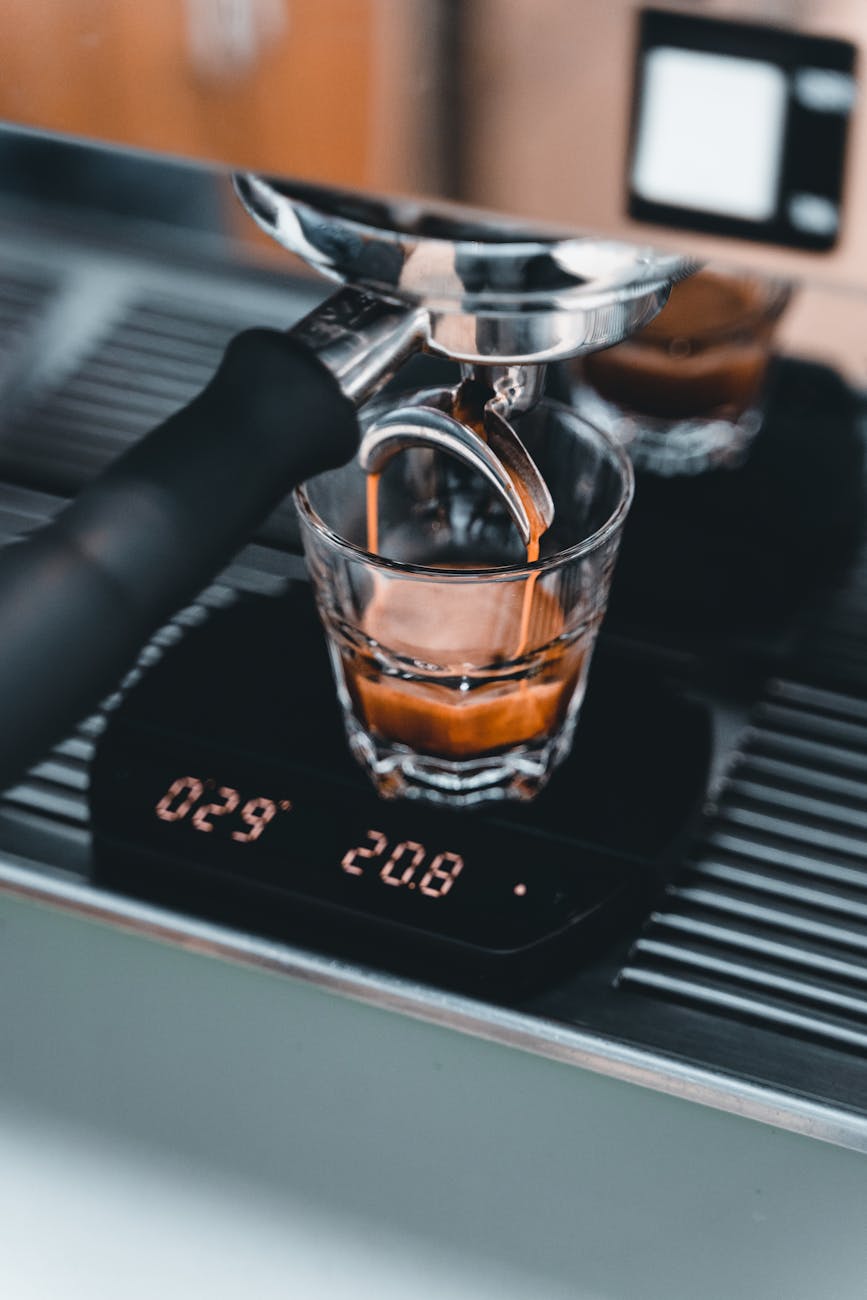
This is the sweet spot. You will feel a firm but manageable resistance as you press the lever. You’ll be able to smoothly ramp up the pressure to your target, perhaps starting with a gentle pre-infusion at 2-3 bars before increasing to a steady 9 bars for the main extraction. The espresso will flow from the spout in a steady, syrupy stream, often described as looking like warm honey. This controlled flow is the physical sign that you’ve found the right grind to achieve a balanced extraction.
The impact on flavor in the cup
The mechanical feedback from the Flair’s lever directly translates to the flavors you’ll experience in your espresso. The terms under-extracted, balanced, and over-extracted describe the taste profiles that result from your grind, pressure, and time parameters.
An under-extracted shot, caused by a coarse grind and low pressure, means the water didn’t have enough time or resistance to pull out the desirable sugars and oils. It only managed to grab the most easily dissolved compounds, which are primarily acids. The result is a shot that tastes overwhelmingly sour, thin, and unsatisfying. It lacks sweetness, body, and complexity.
An over-extracted shot, caused by a grind that is too fine and excessive pressure or time, means the water pulled out everything—including compounds you don’t want. After dissolving the acids and sugars, the water began dissolving bitter, astringent compounds. This results in a shot that is harsh, bitter, and has a drying, chalky aftertaste. Any sweetness is completely masked by these unpleasant flavors.
A balanced extraction is the goal. Here, you’ve used the perfect grind to maintain the right pressure for the right amount of time. You’ve extracted the bright acids and the deep sugars, but stopped before pulling out the harsh bitters. The result is a delicious, complex shot with a pleasant sweetness, a vibrant acidity, and a satisfying, full body that highlights the unique notes of your coffee beans.
| Parameter | Too Coarse (Under-extracted) | Just Right (Balanced) | Too Fine (Over-extracted) |
|---|---|---|---|
| Feel of Lever | Too easy, no resistance | Firm, steady, and controllable | Extremely hard, or won’t move |
| Pressure Reading | Struggles to reach 6 bars | Easy to maintain 6-9 bars | Spikes to 10+ bars, chokes |
| Shot Time | Very fast (<20 seconds) | Ideal (25-35 seconds) | Very slow (>40 seconds) or none |
| Dominant Flavor | Sour, acidic, thin | Sweet, complex, rich body | Bitter, astringent, harsh |
A practical guide to dialing in your grind
Knowing the theory is one thing; applying it is another. “Dialing in” is the iterative process of adjusting your grind to find that sweet spot. Here’s how to approach it methodically:
- Control your variables: To accurately assess your grind, everything else must stay the same. Use the exact same dose of coffee (weigh it with a scale), the same water temperature, and the same tamping technique for every shot. The only thing you should change is the grind setting on your grinder.
- Establish a starting point: Begin with a grind that feels like fine table salt or sand. Pull a shot and take notes. Don’t just taste it—observe it. How did the lever feel? What did the pressure gauge say? How long did it take?
- Taste and adjust: Now, taste the espresso. Is it sour and did it run fast? Your grind is too coarse. Make a small adjustment on your grinder to a finer setting. Is it bitter and did it choke the machine? Your grind is too fine. Make a small adjustment to a coarser setting.
- Repeat the process: Pull another shot with your new grind setting, keeping all other variables constant. Compare it to your last one. Is it better? Are you closer to that balanced flavor profile? Continue this process of making one small adjustment at a time until you produce a shot that is both visually correct and tastes delicious to you.
This process takes patience, but it is the most important skill you will learn as a Flair user. With each adjustment, you are training your senses to connect the feeling of the lever and the sight of the flow with the final taste in the cup.
In conclusion, the relationship between grind size, pressure, and extraction is the heart and soul of making espresso with a Flair. Unlike other machines, the Flair provides raw, unfiltered feedback, making you a central part of the process. Your grind size is not just a setting; it is your primary control for managing the resistance that allows you to build the proper pressure. This pressure, when applied correctly, is what leads to a balanced extraction and a delicious shot. By understanding that a coarse grind leads to sour, under-extracted shots and a fine grind leads to bitter, over-extracted ones, you can begin the rewarding process of dialing in. It is this hands-on journey that makes the Flair so special, turning every cup into a personal achievement.

 No products in the cart.