

Proper storage for your Gaggia portafilter between shots
For the dedicated manual espresso enthusiast, every variable in the brewing process is an opportunity for refinement. From grind size to extraction time, precision is key to achieving a consistently excellent shot. Yet, one of the most overlooked variables is what you do with your Gaggia portafilter in the brief period between shots. While it may seem minor, how you store it—whether for a few seconds or a few minutes—has a direct impact on thermal stability and workflow efficiency. This article explores the technical considerations behind proper portafilter storage, providing a clear guide for experienced home baristas seeking to eliminate inconsistencies and master their craft.
Maintaining thermal stability is the primary goal
The single most important factor governing where to keep your portafilter is thermal stability. The Gaggia group head is a large, heated mass of brass designed to maintain a consistent brewing temperature. Your portafilter, also made of chrome-plated brass, is an integral part of this system. For a stable extraction temperature, the portafilter must be heated to the same temperature as the group head. Locking the portafilter into the group head ensures it is constantly absorbing heat, preventing temperature drops that can lead to sour, under-extracted shots. Removing it for even a short time causes it to cool rapidly, introducing a significant variable into your next extraction.
For this reason, the standard and most recommended practice is to keep the portafilter locked gently into the group head whenever it is not being used for puck preparation. This is not just for long-term storage between sessions; it applies to the moments between pulling consecutive shots.
The dry portafilter versus wet portafilter debate
A common concern among baristas is the presence of residual moisture in a portafilter that has been rinsed and immediately locked back into the hot group head. The argument is that this lingering moisture, or “wet coffee,” can lead to channeling in the subsequent shot by creating wet spots at the bottom of the coffee bed. While this is a valid theoretical concern, its practical impact is often overstated and can be managed with a proper workflow.
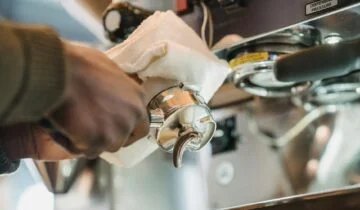
A thorough and consistent puck preparation routine is the solution. After knocking out the spent puck and rinsing the basket, it is crucial to wipe both the inside of the portafilter basket and the bottom of the portafilter itself with a dedicated, dry microfiber cloth. This action takes only a few seconds and effectively removes any problematic residual moisture. Once dried, the portafilter should be returned to the group head to maintain its temperature while you grind and dose your fresh coffee. A disciplined drying step is more reliable than leaving the portafilter out to air dry, which compromises its thermal stability.
Alternative storage locations and their consequences
While locking the portafilter in the group head is ideal, some users opt for alternative locations. Understanding the trade-offs is essential.
- On the drip tray: Placing the portafilter on the drip tray is a common practice. However, it is the least effective for thermal management. The portafilter is exposed to ambient air and will cool down significantly, leading to a noticeable temperature drop during extraction. It also clutters the workspace.
- On top of the machine: The top of the Gaggia Classic and other models serves as a cup warmer and can be a slightly better option than the drip tray. It provides some passive heat, but it will not keep the portafilter at optimal brew temperature. The heat transfer is inefficient compared to direct contact with the group head.
- On a tamping mat: Storing the portafilter on a silicone tamping mat is a clean and stable option for puck preparation, but it offers no thermal benefit. The insulating properties of the silicone will prevent any meaningful heat transfer from the counter or machine.
In short, any location other than the group head will result in a cooler portafilter. This temperature deficit must be overcome during extraction, potentially leading to inconsistency. For the barista focused on repeatability, these alternatives introduce an unnecessary variable.
Impact on workflow and shot consistency
A predictable workflow is the foundation of consistent espresso. Integrating proper portafilter storage into your routine removes a key variable and allows you to focus on the more nuanced aspects of puck preparation and extraction. When pulling multiple shots, the rhythm of your process matters. By immediately cleaning, drying, and returning the portafilter to the group head after each shot, you ensure it is hot and ready for the next one. This practice minimizes temperature fluctuations from the first shot to the last, a critical factor when making drinks for multiple people or when dialing in a new coffee bean.
This discipline creates a closed loop of thermal management. The group head keeps the portafilter hot, and a hot portafilter ensures the brew water temperature is not compromised as it passes through the coffee bed. Breaking this loop by leaving the portafilter on the counter introduces a significant thermal variable that is difficult to compensate for.
Conclusion
For the manual espresso user, mastering the craft is about controlling variables. The storage of your Gaggia portafilter between shots, while seemingly minor, is a crucial element of thermal management and workflow consistency. The most technically sound practice is to keep the portafilter locked into the group head, ensuring it remains at a stable, optimal brewing temperature. Concerns about residual moisture can be fully mitigated by a quick but thorough drying step with a dedicated cloth after rinsing. By integrating this simple, disciplined action into your routine, you eliminate a significant source of temperature-related inconsistency, paving the way for more repeatable and refined extractions. For those seeking to optimize their workflow, high-quality accessories that support a clean and efficient process are available at papelespresso.com.

 No products in the cart.