

How microcontrollers are changing home espresso preparation
The pursuit of the perfect espresso shot at home has long been a blend of art and science. For manual and prosumer espresso enthusiasts, control over variables like temperature, pressure, and time is paramount. Historically, this control was achieved through mechanical means and user skill. Today, the introduction of inexpensive, powerful microcontrollers is quietly revolutionizing the capabilities of home espresso machines. These tiny computers are moving beyond simple automation, offering a level of precision and repeatability that was once exclusive to commercial equipment. For the experienced home barista, this shift does not replace skill but rather enhances it, providing new tools to explore the nuances of coffee extraction with unprecedented detail.
The role of the microcontroller in espresso
At its core, a microcontroller is a compact integrated circuit designed to govern a specific operation in an embedded system. Think of it as a dedicated, miniature computer. In an espresso machine, its primary function is to read data from various sensors and control mechanical components in response. This is a significant leap from traditional machines that rely on simple analog components like pressurestats and bimetallic thermostats, which offer a much lower degree of precision.
Microcontrollers execute instructions from their firmware to manage a closed-loop system. For example:
- A temperature sensor (thermocouple or RTD) sends a signal to the microcontroller.
- The microcontroller compares this reading to a target temperature set by the user.
- If the temperature is too low, it sends a signal to a relay or solid-state relay (SSR) to activate the heating element.
- This process repeats hundreds or thousands of times per minute, keeping the temperature exceptionally stable.
This ability to process information and react in real-time is what unlocks the advanced features now appearing in home machines.
Precision temperature control and stability
One of the most critical variables in espresso extraction is water temperature. Even a small deviation can drastically alter the flavor profile of a shot. Microcontrollers enable the implementation of Proportional-Integral-Derivative (PID) control algorithms, a sophisticated method for maintaining thermal stability. Unlike a basic thermostat that simply turns a heater on or off, causing wide temperature swings, a PID controller continuously modulates power to the heating element.
The microcontroller-based PID anticipates temperature changes and makes fine adjustments to prevent overshooting or undershooting the target. This results in incredibly stable brew water, minimizing one of the most common sources of inconsistency in espresso shots. For the home barista, this means that each shot can be pulled at the precise intended temperature, allowing for more focused experimentation with other variables like grind size and dose.
Advanced pressure and flow profiling
Beyond temperature, microcontrollers have opened the door to dynamic pressure and flow profiling. Traditional pump-driven machines typically operate at a static pressure, usually around nine bars. Microcontrollers, however, can be programmed to control the speed of the pump or manipulate a valve to alter the pressure and flow rate throughout the extraction process.
This allows the user to create custom profiles, such as a long, low-pressure pre-infusion followed by a gradual ramp-up to peak pressure, and then a tapering-off phase to reduce the chance of channeling and bitterness toward the end of the shot. By managing the flow of water with this level of detail, baristas can directly influence which flavor compounds are extracted and at what point, unlocking new possibilities for a given coffee. This turns the machine from a static tool into a dynamic instrument for flavor exploration.
Workflow integration and data logging
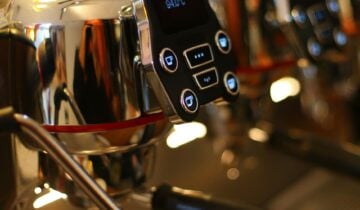
A final, practical advantage of microcontroller integration is the improvement of workflow and the ability to gather data. Many modern machines now incorporate features that were once standalone accessories. For example, microcontrollers can manage built-in scales to provide gravimetric dosing, stopping the shot automatically when a target weight is reached in the cup. They also run the shot timer, display real-time data like temperature and pressure on a screen, and allow users to save and recall specific extraction profiles.
This integration creates a more seamless and repeatable process. Furthermore, some systems offer the ability to log data from each shot, which can be reviewed later to analyze performance and troubleshoot issues. For the meticulous barista, this data-driven feedback loop is invaluable for honing their technique and achieving a deeper understanding of the extraction process.
Conclusion
The integration of microcontrollers into home espresso machines marks a fundamental shift from analog mechanics to digital precision. By enabling sophisticated PID temperature algorithms, dynamic pressure and flow profiling, and integrated workflow features, these tiny processors provide home baristas with an extraordinary level of control. This technology does not diminish the craft of espresso making. Instead, it elevates it by removing sources of mechanical inconsistency and providing powerful new tools for experimentation. It empowers the user to focus more on the coffee itself and less on compensating for the limitations of their equipment. As this technology continues to develop, enthusiasts can find relevant tools and components to explore these advancements at specialized retailers like papelespresso.com.

 No products in the cart.